
AI-Authentic Student Voice Writing: Sound Like You, Not a Template
Using AI in school does not automatically erase your voice. What erases your voice is outsourcing decisions: letting a tool pick your claims, your structure, your evidence, and your tone. If you keep ownership of those decisions, AI can become a drafting assistant, not a ghostwriter.
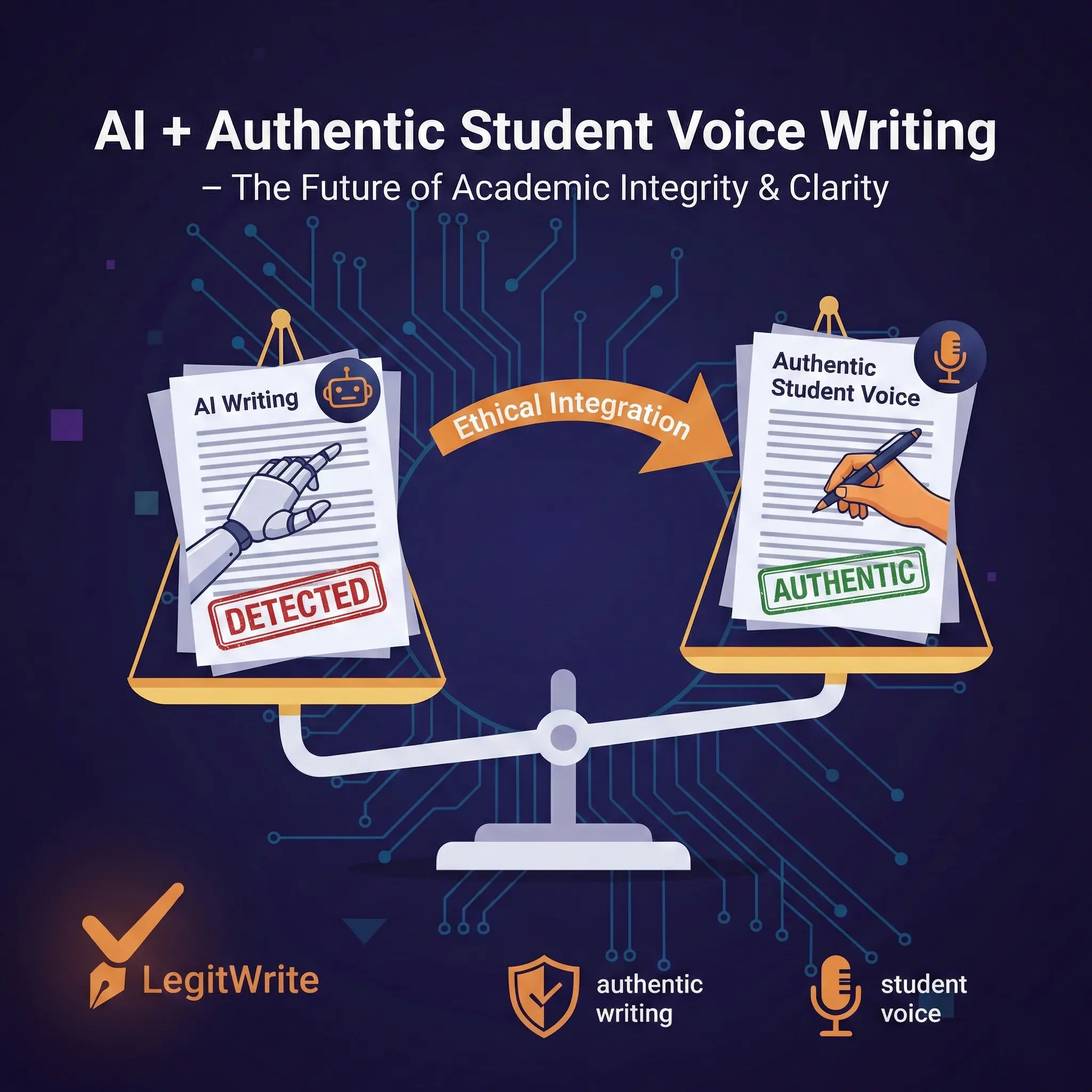
This guide is about producing writing that is:
- Authentic: the ideas reflect your understanding, not generic consensus.
- Accountable: claims are supported by sources you can actually stand behind.
- Recognizably you: your rhythm, priorities, and examples show up on the page.
What "student voice" really is (and why AI flattens it)
Voice is not slang. Voice is the sum of small choices:
- What you notice first.
- What you define carefully (and what you assume).
- What you challenge.
- How you handle uncertainty.
- Which examples you reach for when you explain.
AI tends to flatten those choices into a polished middle. That "middle" sounds smooth, but it often feels like it was written by nobody.
If your draft is technically correct but emotionally neutral, oddly balanced, and filled with safe phrases ("in today's society", "it is important to note"), your voice got averaged out.
The AI-authentic workflow (a repeatable process)
Here is a workflow that keeps your voice intact while still using AI to save time.
Step 1: Write a 6-sentence "voice seed" first (no AI)
Before you ask for help, write this quickly in your own words:
- What is the question, in plain language?
- What do you actually think the answer is?
- What part confuses you or feels contested?
- What is one example from class, life, work, or a reading?
- What would a skeptical reader push back on?
- What do you want the reader to walk away believing?
This seed becomes your anchor. Any AI output that contradicts it is a signal to slow down and re-assert control.
Step 2: Use AI for options, not answers
Good AI prompts ask for choices you can evaluate. Examples:
- "Give me three thesis options that reflect these notes. Make them different in scope and tone."
- "Suggest two structures: one narrative-first, one argument-first."
- "List counterarguments a professor might raise, then suggest ways to respond."
Bad AI prompts ask the model to decide for you:
- "Write my paper about..."
- "Make this sound academic."
You do not want "academic". You want "specific, defensible, and clear".
Step 3: Build a source backbone (and keep it real)
Authentic writing is evidence-driven. AI is not a source. Use AI to find search terms, not citations.
Try this:
- Ask for keywords: "Give me a keyword list to research this topic in academic databases."
- Ask for questions: "What questions should I answer to evaluate Source A vs Source B?"
- Ask for gap checks: "What claim in this outline needs the strongest evidence?"
Then find sources yourself (library database, course readings, credible institutions) and take brief notes in your own language.
Three fast voice tests (use them every time)
1) The "could anyone write this?" test
Highlight any paragraph and ask: if you remove the topic nouns, does it still read as generic advice?
If yes, add one of the following:
- A concrete example you can explain in 2-3 sentences.
- A definition that shows what you mean (not just what the dictionary says).
- A small disagreement with a common framing (even a gentle one).
2) The "stance" test
Most students lose voice by hiding behind neutral phrasing.
Replace:
- "It can be argued that..."
- "Some people believe..."
With:
- "I argue that..."
- "In this paper, I claim..."
You can still be nuanced. But nuance is stronger when you state a position first and then qualify it.
3) The "handprint" test
Your handprint is your pattern: favorite transitions, sentence length variety, and where you insert emphasis.
If the draft is all medium-length sentences with perfect balance, rewrite one paragraph with:
- One short sentence for impact.
- One longer sentence that connects two ideas.
- One deliberate fragment (if your instructor allows it).
Voice often returns when rhythm returns.
The revision move that changes everything: "decision logging"
When you revise with AI, keep a tiny decision log (3-8 bullets). Example:
- Thesis narrowed from "social media harms teens" to "algorithmic feeds intensify comparison stress in first-year students."
- Removed claim about dopamine because I could not support it with a course source.
- Added personal observation from tutoring shift to ground the argument.
This does two things:
- It forces you to own the paper's logic.
- It gives you proof of process if questions come up later.
How to ask AI to "humanize" without faking anything
If you use a rewriting tool, set ethical constraints clearly:
- Keep my facts unchanged.
- Do not add statistics, quotes, or citations.
- Keep first-person perspective where it exists.
- Preserve my key phrases (list them).
Then ask for style transformations that are still yours:
- "Make the transitions less formal and more direct."
- "Reduce filler phrases and tighten verbs."
- "Keep my tone: curious, skeptical, and practical."
Common pitfalls (and how to avoid them)
Pitfall: Over-polished introductions
If the intro sounds like a press release, rewrite it from the inside out:
- Start with a specific scene, question, or tension.
- Say why it matters in your course context, not in "society".
Pitfall: Perfectly symmetrical paragraphs
Humans do not write like templates. Let one paragraph be short if it makes a point quickly. Let another be longer if it needs to explain evidence.
Pitfall: Evidence-shaped like vibes
A paragraph that summarizes "research shows" without naming the study, author, method, or context is not evidence. It is atmosphere.
Fix it by adding:
- Who said it.
- What they studied.
- What they actually found.
- Why it applies here (and what might limit it).
A simple checklist before you submit
- I can explain my thesis out loud in one sentence.
- Every major claim has a source or a clearly labeled personal observation.
- I removed any citation I did not personally open and verify.
- At least once per page, there is something only I would say (example, definition, connection).
- The conclusion does not repeat; it decides.
Final thought: your voice is a set of choices
AI can help you type faster. It cannot replace the thinking that makes writing yours. If you want "AI-authentic" writing, protect the choices that carry voice: your stance, your examples, your definitions, and your evidence.
Write the seed. Use AI for options. Revise with intent. That is how you sound like you, even with modern tools in the loop.