
Navigating Ethics in AI-Assisted Writing: Clear Boundaries, Clean Work
AI-assisted writing can be ethical. It can also quietly become unethical when the tool stops assisting and starts substituting. Most confusion comes from vague language like "don’t use AI" or "AI is allowed for editing" without defining what "editing" actually means.
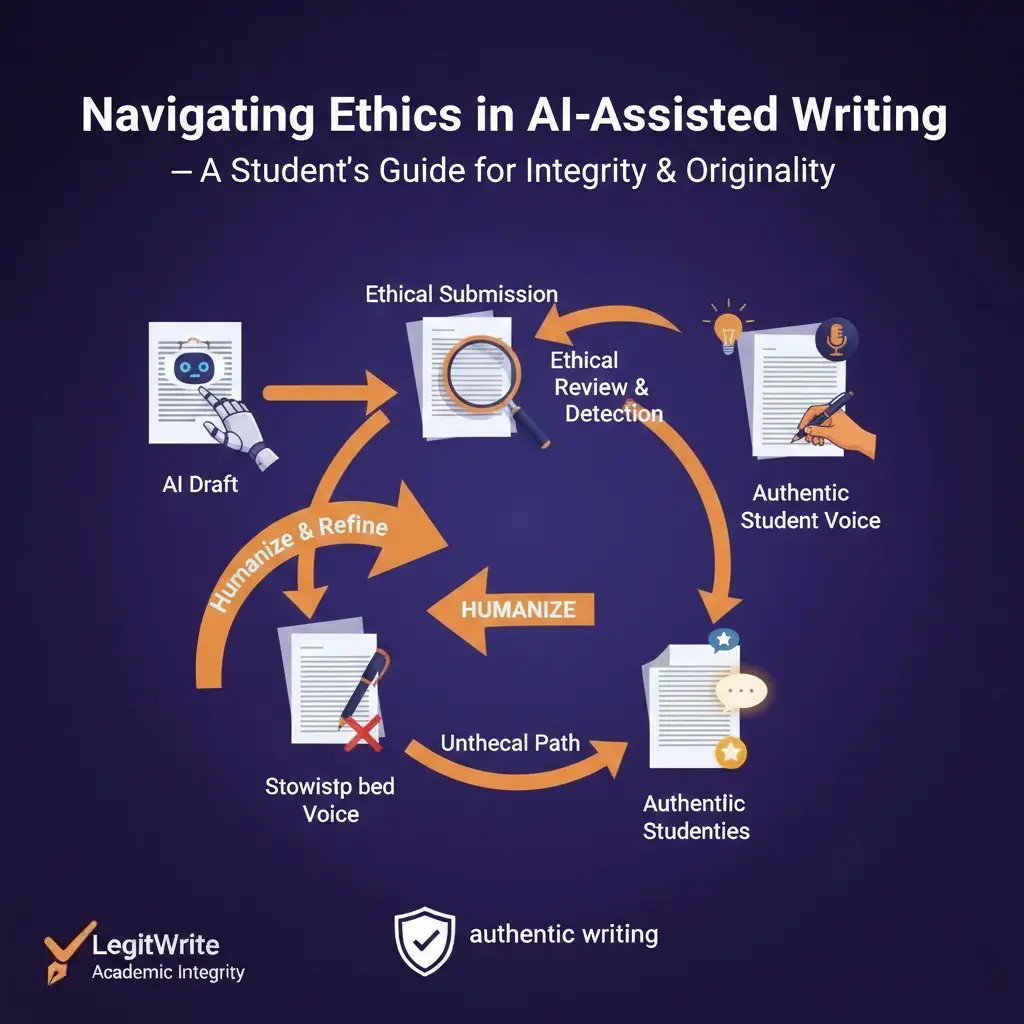
This guide is built around one simple question:
If someone asked me to explain how I arrived at this paragraph, could I honestly describe my own thinking and my own evidence?
If the answer is yes, you’re usually on solid ground. If the answer is "the tool did it", you’re not.
First: ethics is local (your course rules win)
The ethical line is not universal. It depends on:
- Your instructor’s policy and the assignment instructions.
- Your department’s or university’s integrity code.
- The learning objective (is the assignment testing writing skill, analysis, research, or all three?).
If the policy is unclear, ask a specific question:
- "Can I use AI to suggest outline options and improve grammar if I write the analysis and choose all sources?"
Specific usage beats generic "Is AI allowed?"
The clean boundary: assistance vs substitution
Use this rule-of-thumb:
- Assistance improves your work.
- Substitution replaces your work.
Assistance (typically ethical when permitted)
- Brainstorming topics, angles, and research questions.
- Creating outline alternatives for you to choose from.
- Pointing out unclear sentences, weak transitions, or repetitive phrasing.
- Helping you plan revision ("what should I tighten first?").
- Explaining a concept after you attempt it (tutoring-style).
Substitution (typically unethical for graded writing)
- Generating the thesis, argument, or analysis that you did not create.
- Writing full sections that you only lightly edit.
- Producing claims you don’t understand or cannot defend in conversation.
- Producing citations or quotes you did not personally verify.
The tell is authorship: who made the intellectual decisions?
Green / Yellow / Red: a quick ethics filter
Green (low-risk, commonly allowed)
- Spellcheck, grammar, clarity edits.
- Asking for feedback on whether your argument is coherent.
- Generating questions to pressure-test your thesis.
- Summarizing your own notes into a study guide (if permitted).
Yellow (ask first, depends on the class)
- Rewriting paragraphs to "sound more academic".
- Translating a full draft.
- Summarizing sources you did not read in full.
- Producing code/proofs/solutions in courses where process is graded.
If you do this, be ready to disclose and document your process.
Red (avoid)
- "Write my essay about X."
- "Make this undetectable."
- "Generate 10 citations with links."
- Any workflow where you cannot trace claims back to a real source or your own reasoning.
Disclosure: how to be transparent without turning in a confession
If your class requires disclosure, keep it short and factual. You are describing assistance, not asking forgiveness.
Examples:
- "I used AI to suggest an outline and to edit for clarity. I wrote the argument and verified all sources myself."
- "I used AI for grammar and transitions only; it did not generate ideas, analysis, or citations."
If disclosure is optional, you can still self-document privately so you can defend your process if needed.
Sources: AI is not evidence
AI can help you search, but it should not be treated as a research source unless your discipline explicitly instructs you how to cite it.
Practical standards that keep you safe:
- Never cite what you didn’t open.
- Never quote what you didn’t see on the page.
- Never use a reference list generated by AI without manual verification.
If you want AI help here, use it for queries:
- "Give me database keywords and search strings for this topic."
- "What kinds of studies would test this claim?"
Then do the reading yourself.
Process evidence: the simplest way to protect yourself
Keep lightweight proof of authorship:
- A rough outline with your notes.
- One or two intermediate drafts.
- A list of sources you actually used (with PDFs or links).
- A 5-bullet decision log of major changes.
This is not busywork. It makes your work defensible.
Ethical prompting: force the tool into a support role
Prompts that keep you in control:
- "Ask me five questions that would make my thesis more precise."
- "Point out where my reasoning jumps, but don’t rewrite it yet."
- "Rewrite for clarity only; do not add facts, statistics, quotes, or citations."
- "Give two counterarguments; wait for my response before suggesting revisions."
Prompts that quietly outsource authorship:
- "Write a strong argument for..."
- "Make it sound like a college essay."
- "Add evidence and citations."
If the prompt asks the tool to invent content, you’re stepping into substitution territory.
The best integrity test: can you defend the work out loud?
Before you submit, try answering these without looking at the paper:
- What is your thesis in one sentence?
- What is your strongest piece of evidence and why?
- What would a skeptic disagree with?
- What did you change during revision, and why?
If you can answer cleanly, your workflow is probably ethical.
Final thought: ethics is a writing skill now
In 2026, "how did you write this?" is becoming part of the assignment, even when it isn’t written on the page. The safest approach is not to avoid tools completely or to hide them. It’s to use tools in a way that preserves authorship, keeps sources verifiable, and stays aligned with the rules of your course.
AI can assist. Your job is to remain the author.