
How to Humanize ChatGPT Text
ChatGPT has made it easier than ever to produce a first draft. But that speed creates a problem: detectors like GPTZero, Turnitin, and Originality.ai are trained specifically on the kind of text ChatGPT produces. Paste a raw ChatGPT essay into any serious detector and you will almost always see a high AI probability score.
The question is not whether detectors flag ChatGPT text. They do, consistently. The question is why they flag it, and what you have to change to make them stop.
Why ChatGPT text gets flagged
AI detectors do not search for specific phrases. They do not flag "furthermore" or "it is worth noting" in isolation. What they measure is the statistical structure of the text as a whole.
ChatGPT generates text by predicting the most probable next token at each step. The result is writing that is statistically smooth — every sentence flows naturally into the next, every paragraph has a similar shape, and the rhetorical arc is predictable from the first line.
That smoothness is the fingerprint. Detectors measure it in a few key ways:
- Perplexity: how surprising or unpredictable the word choices are. ChatGPT text has low perplexity — it is highly predictable.
- Burstiness: how much sentence length varies within a paragraph. Human writing is bursty — short punchy sentences followed by longer explanatory ones. ChatGPT writing has low burstiness.
- Transition patterns: how predictably paragraphs open and close. ChatGPT tends to use the same transitional structures across the whole document.
What the ChatGPT fingerprint looks like
You can usually spot it without a detector. Look for:
- Sentences that are all roughly the same length
- Paragraphs that open with a topic sentence and close with a summary
- Transitions like "It is important to note that," "Furthermore," "In conclusion"
- An introduction that defines all terms and a conclusion that restates the main points
- No hedges, contradictions, or moments of uncertainty
- No examples that feel specific or experiential
That pattern is helpful for generating a passable first draft. It is the exact pattern that makes a detector flag the text with 90%+ AI confidence.
Why paraphrasing doesn't fix it
A lot of people try to humanize ChatGPT text by running it through a paraphrasing tool — QuillBot, Wordtune, or similar. The score sometimes drops a little. But reliably passing GPTZero or Turnitin requires something different.
Paraphrasing tools typically:
- replace words with synonyms
- reorder some clauses
- keep the same sentence structure
- keep the same paragraph architecture
When sentence rhythm, paragraph shape, and rhetorical progression stay the same, the statistical fingerprint stays largely the same. The text may look different to a human reader. To a detector, it still behaves like ChatGPT output.
The fingerprint is structural. Fixing it requires structural changes.
What structural rewriting actually changes
Structural rewriting targets the statistical patterns directly. It is a different kind of edit than paraphrasing.
Sentence length variation
Human writers naturally break into short bursts and expand into longer explanations. Deliberately varying sentence length — mixing 6-word sentences with 25-word sentences in the same paragraph — increases burstiness toward human norms.
Paragraph pacing and rhythm
ChatGPT paragraphs tend to be 3–5 sentences long with a predictable internal structure. Structural rewriting breaks this: some paragraphs are one sentence, some are longer, and the internal logic does not always follow a topic-sentence-plus-development format.
Introduction and conclusion rewrites
Introductions and conclusions carry a disproportionate amount of the AI signal. ChatGPT almost always opens with a broad framing statement and closes with a summary of the main points. Restructuring these sections — opening with a specific claim or question, ending with an implication rather than a recap — removes some of the strongest AI signals in the document.
Step-by-step humanization workflow
Here is a practical workflow for humanizing a ChatGPT draft manually:
- Run the draft through a detector first. Note which sections score highest. These are your priority targets.
- Rewrite the introduction. Replace the broad framing paragraph with something specific — a claim, a tension, a question, or a concrete observation.
- Break up same-length sentence runs. Find any 3+ consecutive sentences of similar length and shorten one drastically or expand another. Aim for visible variation.
- Remove or replace predictable transition phrases. "Furthermore," "It is important to note," and "In conclusion" are extremely high-signal. Cut them or replace with something more natural.
- Rewrite the conclusion. Instead of restating the main points, push toward an implication, a remaining question, or a practical takeaway in plain language.
- Re-run the detector. Check the score and identify any paragraphs still flagging high.
- Repeat on flagged sections. Focus the next pass on the specific paragraphs that remain above your target score.
This process is effective but time-consuming at scale. For a 1000-word essay, one pass typically takes 20–40 minutes manually.
Using LegitWrite to humanize ChatGPT text
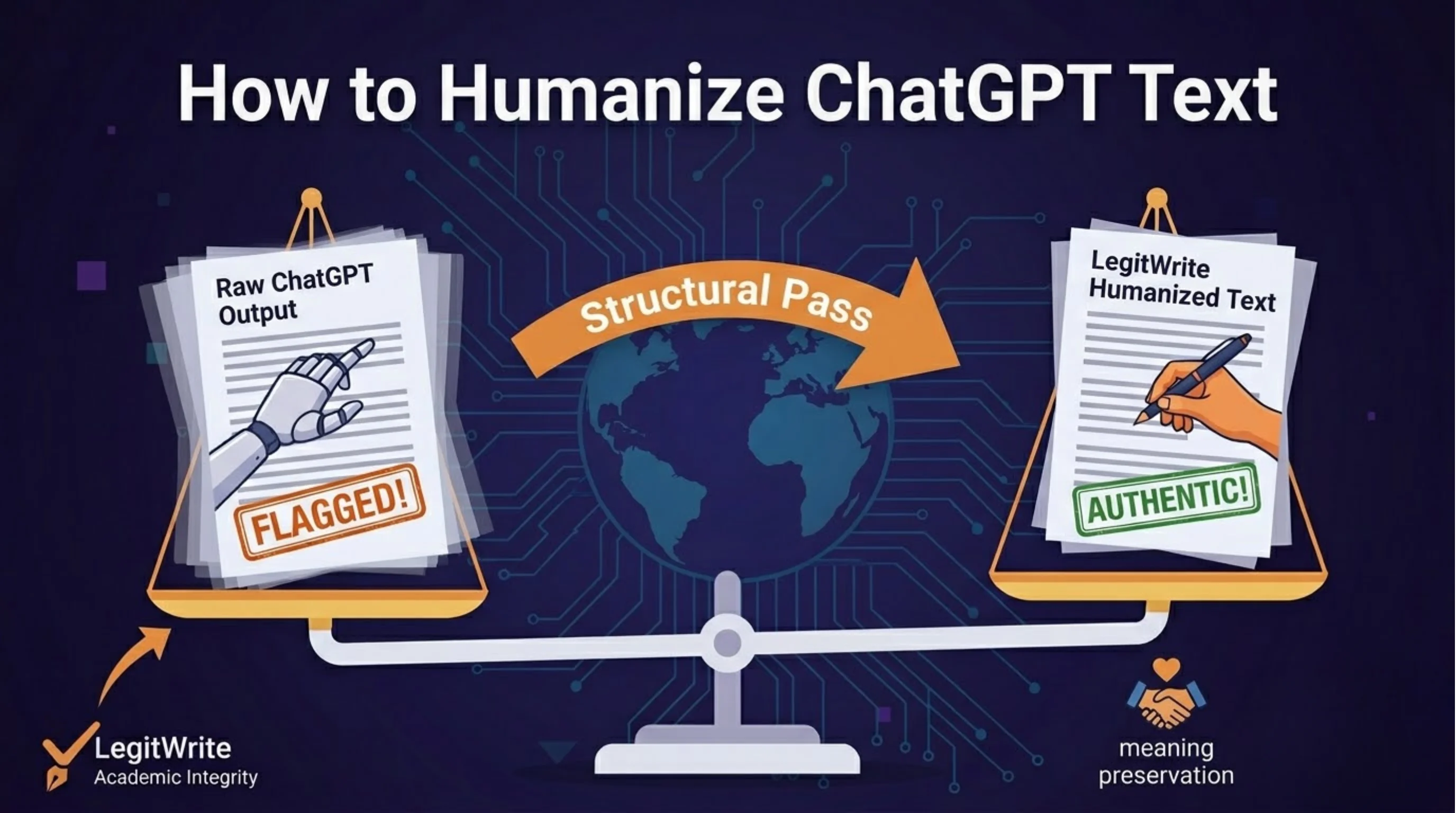
LegitWrite automates the structural pass. Instead of manually editing sentence by sentence, you paste the ChatGPT text, select a tone preset (Formal, Casual, or Auto), and LegitWrite restructures the text at the paragraph and sentence level — targeting the patterns that detectors measure.
It is not a synonym replacer. It rebuilds sentence rhythm, adjusts paragraph pacing, and rewrites the structural zones (intros, transitions, conclusions) that carry the strongest AI signal. The meaning, citations, and claims stay intact.
The workflow:
- Paste your ChatGPT text into LegitWrite
- Select your tone (Formal for academic work, Auto for general content)
- Run the humanization pass
- Copy the result and test it in GPTZero, Turnitin, or Originality.ai
How much does the score drop?
Raw ChatGPT text typically scores 85–98% AI probability on GPTZero and triggers the AI writing flag on Turnitin. After a full structural rewrite with LegitWrite, most users see scores drop to below 30% — and many drop below 15%.
The drop depends on:
- How uniformly structured the original text is. A tightly structured academic essay takes more work than a conversational blog post.
- The detector in use. Turnitin's current AI detection is generally harder to move than GPTZero's free tier.
- Whether citations and technical terms constrain rewriting. Passages locked around specific citations have fewer structural options.
Common mistakes when humanizing ChatGPT text
Most people who fail to lower their scores make one of these errors:
- Only paraphrasing, not restructuring. Word-level changes without structural changes leave the fingerprint largely intact.
- Skipping the introduction and conclusion. These sections have the highest signal density. Leaving them untouched means the score stays high even if the body paragraphs improve.
- Running one pass and stopping. On a long or heavily AI-structured draft, one pass may not be enough. Check the score after each pass and target the remaining high-signal sections.
- Using an aggressive paraphraser that distorts meaning. Some tools rewrite citations, soften factual claims, or introduce errors in technical passages. Meaning preservation matters as much as score reduction.
Final verdict
ChatGPT text gets flagged because of its statistical structure, not its vocabulary. Paraphrasing changes the surface but often leaves the structure intact. Structural rewriting — varying sentence length, breaking paragraph uniformity, rebuilding introductions and conclusions — targets the patterns that detectors actually measure.
The manual workflow works but takes time. LegitWrite automates the structural pass and consistently reduces scores on GPTZero, Turnitin, and Originality.ai without distorting meaning or citations.
If you are working with ChatGPT output that needs to read as human-written, structural rewriting is the approach that actually moves the needle.