
How to Make AI Writing Sound Human (Without a Paraphraser)
Most people try to make AI writing sound human by reaching for a paraphraser. That usually means synonym swaps, sentence shuffling, and a slightly different version of the same machine rhythm.
The reason that approach disappoints is simple: human-sounding writing is not a vocabulary problem. It is a structure problem. Human writing carries unevenness, emphasis, specificity, and decision-making at the sentence and paragraph level. AI writing often sounds clean, coherent, and readable, but too regular.
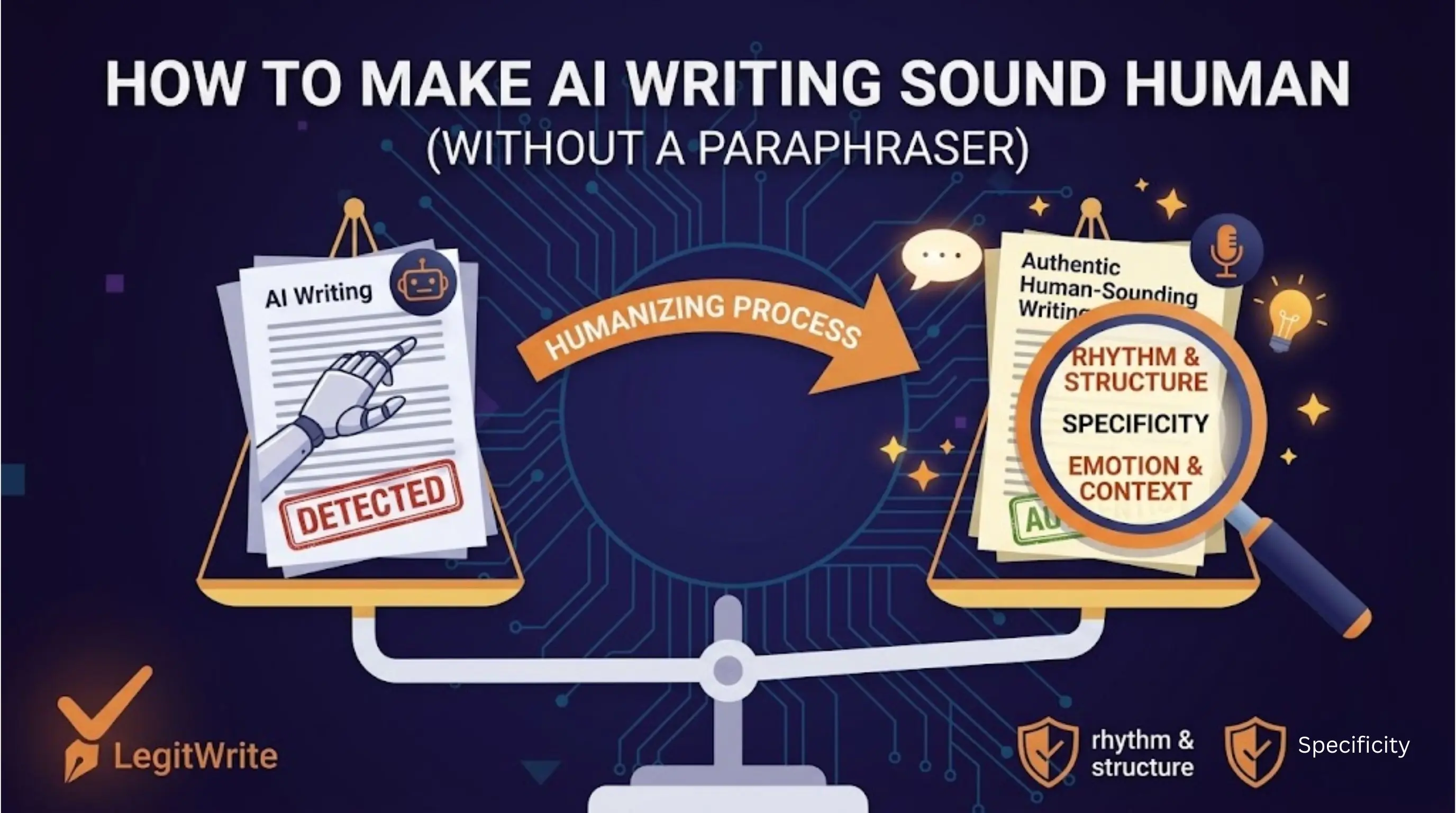
If you want AI writing to sound human, you need to rewrite how it moves, not just how it phrases. That means working on rhythm, logic, transitions, examples, and voice. Below is a practical process that does that without relying on a paraphraser.
Why paraphrasers usually fail
A paraphraser can make a sentence look different. It rarely makes the writing feel authored.
| Paraphraser habit | Why it sounds artificial |
|---|---|
| swaps obvious synonyms | meaning often stays generic and flat |
| keeps the same sentence architecture | detector-relevant structure stays intact |
| rewrites everything at the same intensity | human writing varies by section |
| over-polishes transitions | creates a stiff, tutorial-like tone |
That is why paraphrased AI text often still sounds like AI text. The surface changed. The fingerprint did not.
Step 1: identify what sounds machine-made
Before editing, diagnose the real problem. AI text often gives itself away through:
- sentence lengths that are too evenly distributed
- transitions like "furthermore" and "it is worth noting that" used too often
- paragraphs that all open and close in the same way
- explanations that are correct but emotionally neutral
- statements that are broad when a human would be concrete
Read the draft out loud. If it sounds like it was written by someone who never hesitates, never zooms in, and never changes pace, that is your cue. Human writing has texture.
Step 2: rewrite paragraphs, not isolated lines
One of the biggest mistakes people make is editing sentence by sentence. That tends to preserve the original paragraph rhythm.
Instead:
- read the full paragraph
- identify its actual job
- rewrite the paragraph around that job
Maybe the paragraph should:
- define a concept
- compare two tools
- challenge a common assumption
- give a practical example
- resolve a reader anxiety
Once you know the paragraph's purpose, rewrite it like a person explaining that idea to another person, not like a system trying to complete a prompt.
Step 3: vary sentence rhythm on purpose
Human writing is not uniformly elegant. It speeds up. It slows down. It gets blunt when emphasis matters.
Try this pattern in revision:
- open with a short sentence when you want clarity
- follow with a longer analytical sentence that develops the point
- cut the next sentence down again for emphasis
For example:
AI writing is often too balanced. Every sentence arrives at the same pace. That is exactly why it can feel correct but emotionally unconvincing.
This kind of rhythm shift is difficult for generic paraphrasers to produce consistently. It is also one of the easiest ways to make text feel more human.
Step 4: replace generic claims with specific observations
AI loves safe generalities:
- "This can be beneficial in many situations."
- "There are several important factors to consider."
- "This highlights the significance of the issue."
Humans tend to say what they actually mean:
- "This matters most when the introduction was AI-generated but the rest of the essay was not."
- "The problem is usually not the facts. It is the predictability of the phrasing."
- "This is where students get into trouble: the paper sounds polished, but not personal."
Specificity creates authorship. It also improves SEO because search-driven readers want usable answers, not abstract filler.
Step 5: stop overusing perfect transitions
A lot of AI writing sounds fake because it moves too smoothly. Every paragraph connects with textbook neatness. Real writers are less symmetrical.
Instead of forcing transitions everywhere:
- let some paragraphs begin directly
- use contrast naturally, not ceremonially
- remove bridge sentences that merely announce what comes next
You do not need to write:
Furthermore, it is important to note that there are several additional factors.
You can write:
There is another reason this matters.
Or even:
The bigger problem comes later.
The point is not to sound casual at all times. The point is to sound chosen rather than auto-completed.
Step 6: inject human hierarchy into the draft
AI often assigns equal weight to everything. A human writer does not. Humans signal priority.
To create that effect:
- choose one idea to emphasize
- compress the less important parts
- use fragments carefully where emphasis benefits
- repeat a phrase once if it strengthens the argument
This gives the writing shape. It tells the reader, "this is the main thing," instead of treating all information as equally polished output.
Step 7: add one layer of lived context
You do not need to turn every article into memoir. But one layer of real-world context helps a lot:
- a classroom situation
- a workflow problem
- a publishing scenario
- a client misunderstanding
- an editorial decision
That context makes the writing less generic and more situated. It also reduces the "omniscient explanation engine" effect that machine text often has.
For example, compare:
AI detectors can sometimes produce false positives.
With:
False positives are where content teams lose trust in detectors. A writer can submit a piece they drafted manually, and the score still comes back suspicious because the prose is too predictable.
The second sentence is not just longer. It is anchored in a realistic use case.
Step 8: rewrite the beginning and ending from scratch
Introductions and conclusions are the most dangerous sections to leave untouched because they are where AI tends to be most obvious.
AI intros often do three things:
- announce the topic too neatly
- summarize what will follow
- sound universally applicable
AI conclusions often:
- restate the article in a polished, generic way
- end with broad language about "the importance of understanding"
- avoid sharp final judgment
Rewrite these sections manually. Even if you keep parts of the middle, the opening and closing should sound like your own logic.
Step 9: use a detector-aware workflow, not a paraphrasing workflow
If the text needs to pass editorial or academic review, do not use tools that only promise "rewritten" output. Use a workflow that focuses on the signals detectors actually evaluate:
- sentence predictability
- burstiness
- structural variation
- paragraph-level rhythm
That is the difference between paraphrasing and humanizing. Paraphrasing changes wording. Humanizing changes the writing pattern itself.
A practical rewrite workflow you can use today
If you have a raw AI draft, this is a stronger process than running it through a paraphraser:
| Stage | What to do |
|---|---|
| Diagnose | Mark the most generic or overly polished sections |
| Rebuild | Rewrite by paragraph purpose, not by synonym |
| Vary | Change sentence length and pacing intentionally |
| Ground | Add concrete examples, stakes, or context |
| Finalize | Rewrite intro and conclusion from scratch |
This process takes longer than one-click paraphrasing. It also produces writing that sounds dramatically more human.
Common mistakes to avoid
Mistake 1: editing only a few words
This is the classic "replace utilize with use" move. It rarely helps meaningfully.
Mistake 2: making the draft too formal
People often try to sound more "serious" when hiding AI-like phrasing. That can make the text even more detector-prone because it becomes more predictable.
Mistake 3: flattening your own voice
If your natural writing style is direct, keep that. If it is analytical, keep that. Humanizing does not mean making everything sound casual.
Mistake 4: rewriting facts along with structure
You want to change how the text moves, not what it says. Dates, citations, product names, and claims should remain stable.
What to do next
If your goal is to make AI writing sound human without using a paraphraser, focus on structure first: paragraph purpose, sentence rhythm, specificity, and voice hierarchy.
If you want a faster version of that workflow, LegitWrite's free AI humanizer is built around structural rewriting rather than synonym swapping. It is designed for the exact problem paraphrasers miss: making the text read like a human actually wrote it, not just like the words got shuffled.
The real shift is mental. Stop asking, "How do I reword this?" Start asking, "How would a real person actually write this idea?"