
How to Humanize AI Text for Academic Papers
Humanizing AI text for academic writing is not the same problem as humanizing AI text for blogs, product copy, or social posts. Academic papers have constraints that make careless rewriting dangerous: citations must stay exact, claims must remain defensible, and register matters almost as much as content.
That is why so many students and researchers make the same mistake. They realize their AI-assisted draft feels risky, run it through a paraphraser, and end up with something that is both detector-prone and academically weaker.
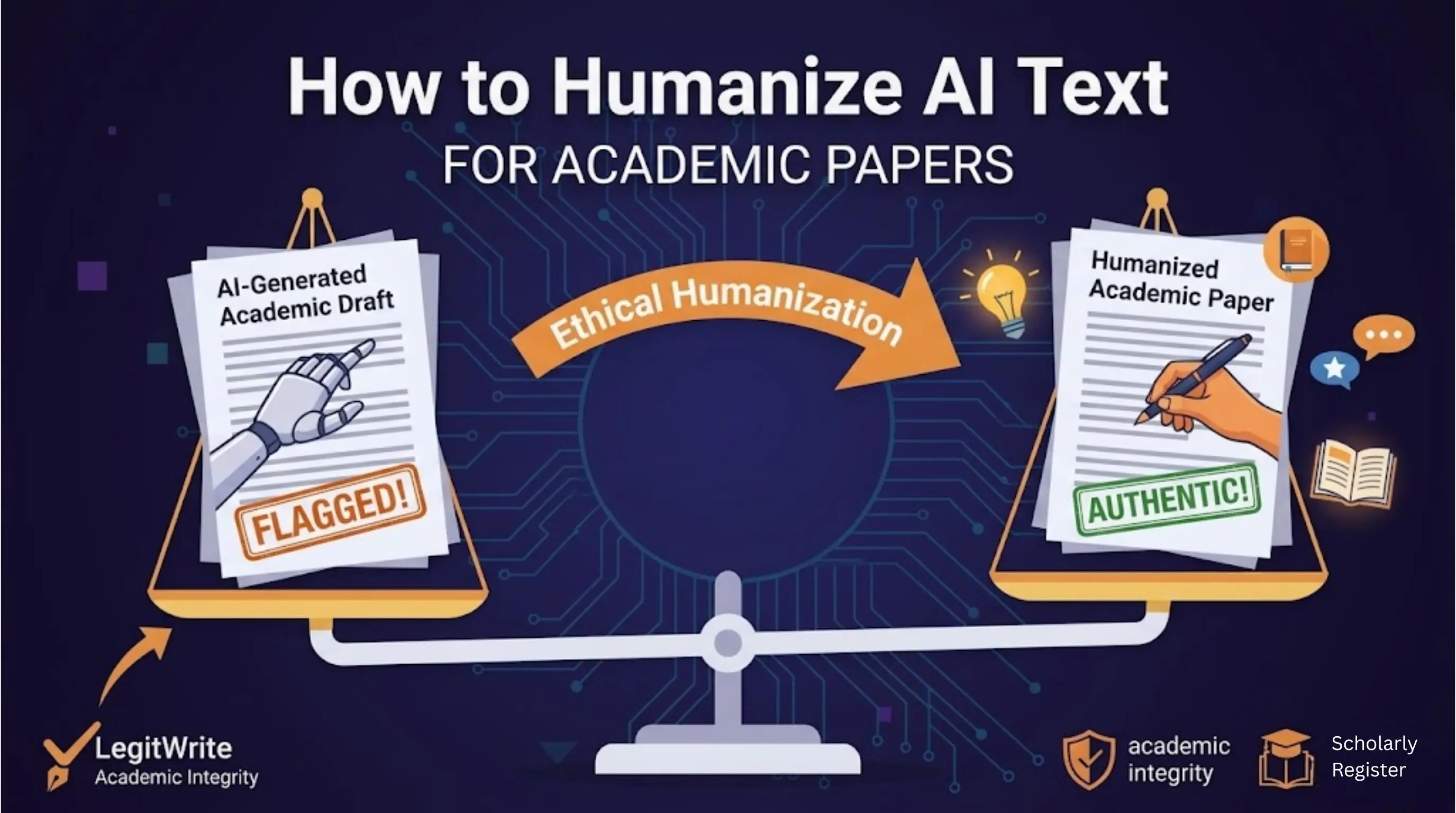
If you want to humanize AI text for academic papers properly, the goal is not to make the paper sound casual. The goal is to remove machine-like structure while preserving academic rigor.
Why academic papers are a special case
Academic writing already has characteristics that overlap with AI output:
- formal register
- careful transitions
- explicit argument structure
- repeated terminology
- constrained tone
That means academic papers are more vulnerable to false positives and detector suspicion even before AI is involved. When AI does generate or heavily shape the draft, the risk increases further because the prose often becomes:
- too uniform
- too polished
- too balanced
- too predictable sentence by sentence
In other words, academic writing is exactly where you must preserve precision while reducing predictability.
What should never change in an academic rewrite
Before you change anything, lock the parts that are academically non-negotiable.
| Must preserve | Why |
|---|---|
| citations | rewording them carelessly can distort attribution |
| dates and figures | small errors can undermine the paper |
| thesis statement meaning | argument drift weakens defensibility |
| disciplinary vocabulary | over-simplifying can damage academic register |
| methodology and findings | precision matters more than style here |
This is where many general rewriting tools fail. They optimize for different wording, not for academic integrity.
What detectors usually flag in academic AI text
Turnitin, GPTZero, Originality.ai, and similar tools often react strongly to the same parts of an academic paper:
- introduction paragraphs
- literature review summaries
- thesis framing
- topic sentence chains
- conclusion paragraphs
These sections are vulnerable because AI tends to write them with perfect symmetry. Every sentence feels competent. Very little feels authored.
The core issue is usually not whether the facts are correct. It is whether the structure feels overly machine-regular.
Step 1: keep the argument, rewrite the rhythm
The first principle of academic humanization is simple: change form before content.
You are not trying to invent a new claim. You are trying to make the same claim sound like a human academic writer actually worked through it.
That means changing:
- sentence length variation
- how evidence is introduced
- where emphasis lands
- how paragraphs open and close
It does not mean changing:
- the core interpretation
- the cited support
- the stated method
- the factual architecture of the paper
Step 2: rewrite the introduction manually
Introductions are where AI often sounds most obvious in academic work. They are too smooth, too comprehensive, and too balanced.
A human academic introduction often contains:
- a more selective opening move
- sharper prioritization
- a slightly less symmetrical progression
- a clearer sense of why this exact paper matters
Instead of letting the intro sound like a textbook template, rewrite it around a specific argumentative purpose. What is this paper actually trying to establish? What tension, gap, or claim drives it?
That usually produces an introduction that feels more authored and less generic.
Step 3: vary sentence pressure within paragraphs
Academic AI writing often makes every sentence feel equally polished. Human academic writing does not.
Try revising paragraphs so they contain:
- one short clarifying sentence
- one denser analytic sentence
- one sentence that names the implication directly
This creates intellectual rhythm. It also helps detectors see more natural variation in structure.
Step 4: reduce generic transition dependence
AI loves transitions such as:
- furthermore
- moreover
- in addition
- it is important to note
- it can be argued that
These phrases are not wrong. They are just overused in generated academic text.
Replace them where possible with more direct movement:
- "A second issue is..."
- "The evidence becomes stronger here."
- "This matters for two reasons."
- "The contrast is sharper in..."
Your paper stays formal, but it becomes less templated.
Step 5: check citation-bearing sentences separately
Any sentence that contains a citation should be handled carefully. You want to preserve:
- the claim being attributed
- the scope of the claim
- the cited author's position
- the surrounding context
This is why aggressive paraphrasing can become academically dangerous. A sentence may look different while subtly shifting who argued what or how strong the claim was.
The safest workflow is:
- isolate citation-bearing sentences
- revise only the surrounding structure if needed
- keep the cited proposition stable
Step 6: fix conclusions aggressively
Conclusions are another high-risk section because AI tends to summarize beautifully and vaguely at the same time.
A human conclusion is often stronger when it:
- makes one final judgment clearly
- names the implication directly
- avoids generic "in conclusion" filler
- resists sounding universally polished
The best conclusion is not necessarily the smoothest one. It is the one that sounds like a human mind reached a position and ended on purpose.
Common mistakes students make
Mistake 1: using a paraphraser on the whole paper
This can:
- distort meaning
- flatten disciplinary language
- create awkward citation sentences
- preserve the deeper AI fingerprint anyway
Mistake 2: making the paper less academic
Humanizing does not mean casualizing. Academic writing still needs:
- precision
- controlled tone
- formal vocabulary where appropriate
The target is not "more conversational." The target is "less statistically machine-like."
Mistake 3: ignoring the highest-risk sections
Students often focus on body paragraphs and forget the intro and conclusion. That is usually backward.
Mistake 4: changing facts to change style
You should not need to alter evidence or claims just to make the prose read more human.
A safer academic humanization workflow
| Stage | What to do |
|---|---|
| Lock | Protect citations, data, dates, and thesis meaning |
| Review | Identify intro, conclusion, and topic sentences as highest-risk |
| Rebuild | Rewrite paragraph rhythm and sentence variation |
| Validate | Check that citation meaning and register stayed intact |
| Final check | Re-read for natural academic flow, not just rewritten wording |
This process is slower than one-click paraphrasing, but it is much safer for serious academic work.
What this means in practice
If you used AI to help draft an academic paper, the safest path is not to hide that help under a blanket of synonyms. It is to make sure the final paper actually reflects human revision at the structural level.
That means the paper should sound like:
- a writer making selective emphasis decisions
- a researcher moving carefully through evidence
- a student or scholar with a point of view
Not like a generalized answer engine outputting clean prose.
What to do next
If your main concern is making an AI-assisted academic draft safer for Turnitin, GPTZero, and similar detectors without damaging citations or argument logic, start with a workflow built for academic text rather than generic paraphrasing.
LegitWrite's humanize AI text for students page is the best next step if your draft is for coursework, essays, dissertations, or research-heavy submissions. The focus there is exactly what academic humanization requires: preserving meaning while changing the machine-like structure that detectors score.
The key principle is simple. In academic writing, good humanization protects the scholarship first and rewrites the signal second.