
Academic Integrity and AI Writing Tools: What Students Need to Know in 2026
By 2026, the question is no longer whether students use AI writing tools. Many do. The more important question is how they use them, how institutions interpret that use, and where the line sits between acceptable support and academic misconduct.
That line is not the same everywhere. It changes by school, course, instructor, assignment, and discipline. But one thing is consistent across almost all serious policies: academic integrity still depends on authorship, accountability, and truthful representation of your work.
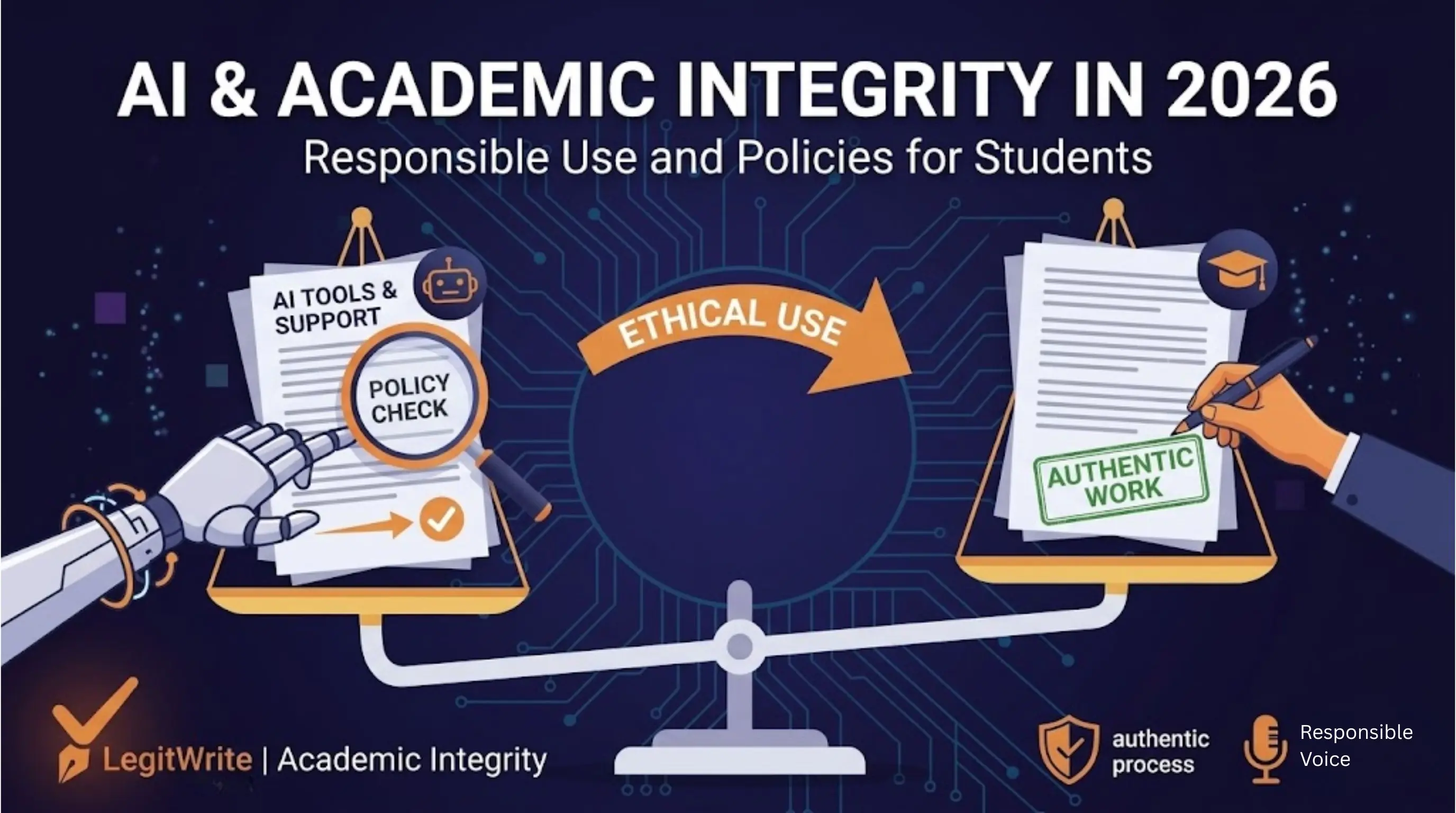
If students treat AI as a shortcut that replaces thinking, the risk is obvious. If they treat AI as a drafting or support layer without understanding policy boundaries, the risk is subtler but still real. The safest path is not fear or blind reliance. It is informed use.
Why this topic matters more in 2026 than it did before
Three changes have made the issue sharper.
AI tools are now normal
Students use AI for:
- brainstorming
- outlining
- summarizing readings
- clarifying concepts
- editing prose
- translating or simplifying explanations
This means integrity questions are no longer rare edge cases.
Institutional policies are still uneven
Some instructors allow AI for ideation but not drafting. Others allow AI if disclosed. Others prohibit it entirely for specific assignments. There is no universal rule students can safely assume.
Detection is part of the environment
Even where policy is flexible, students still face platforms like Turnitin, GPTZero, or faculty review practices shaped by AI detection culture.
So the challenge is not only ethical. It is operational.
Academic integrity is about representation, not just originality
Many students still think integrity simply means "did I copy from somewhere else?" That is only part of it.
Academic integrity also asks:
- whose reasoning is this?
- whose wording is this?
- whose interpretation is this?
- what are you representing as your own work?
This is why AI complicates the issue. A student may not be plagiarizing in the traditional sense, yet may still be misrepresenting authorship if the core thinking or expression was outsourced.
That is the principle beneath most policy language, even when the wording varies.
The difference between support use and substitute use
A useful way to think about AI tools is to separate support use from substitute use.
| Type of use | What it looks like | Integrity risk |
|---|---|---|
| support use | brainstorming, outlining, language cleanup, concept clarification | lower, if allowed by policy and transparently used |
| substitute use | AI writes the draft, argument, analysis, or final response for you | high |
This distinction matters because not all AI use is equally problematic. A grammar suggestion is not the same as an AI-generated essay section. An outline prompt is not the same as outsourcing your interpretation of a reading.
The more AI replaces your intellectual work, the greater the integrity risk becomes.
Why disclosure matters
In 2026, many schools are moving toward disclosure-based frameworks. That means the issue is not just whether AI was used, but whether that use was acknowledged honestly.
Disclosure matters because it protects three things:
- fairness between students
- instructor trust
- the integrity of assessment itself
If a policy allows limited AI assistance, disclosure can make that use legitimate. If a policy prohibits AI use, disclosure can still show honesty even when the choice itself violated the assignment rule.
Students often fear disclosure because they think it automatically incriminates them. In reality, failing to disclose is often what turns an arguable case into a trust problem.
Why detectors are not the same as policy
Students frequently confuse AI detection with academic integrity policy. They are not the same.
A detector gives a probability-style signal about the text. A policy tells you what is allowed, what is not, and what review process follows when concerns arise.
That means:
- a low detector score does not prove compliant use
- a high detector score does not prove misconduct
Detectors are inputs. Policies define consequences.
This is one reason students should read the assignment rules themselves instead of assuming the software defines the rule.
The most common student mistakes
Integrity problems often come from bad assumptions rather than obvious cheating.
Mistake 1: assuming "everyone uses it" means it is allowed
Widespread use does not equal permission.
Mistake 2: using AI to draft analysis, then lightly editing it
Light revision does not change who produced the underlying reasoning.
Mistake 3: ignoring subject-specific risk
An AI-assisted brainstorming step may be tolerated in one class and unacceptable in another, especially in writing-heavy or reflective assessment.
Mistake 4: trusting detectors as the main standard
Students sometimes focus only on "Will it pass Turnitin?" when the real issue is whether the work honestly reflects their own thinking and follows course rules.
A safer model for using AI in coursework
If you do use AI tools, a safer model looks like this:
- do the reading and thinking yourself first
- use AI only for support tasks allowed by the course
- keep notes or drafts showing your process
- rewrite in your own structure and voice
- disclose use where required
This model keeps the student at the center of the work rather than turning AI into the author.
Why students get flagged even when their intentions are not dishonest
Not every flagged paper comes from intentional misuse. Sometimes students create risk because they over-rely on AI for:
- smoothing language
- drafting transitions
- restructuring whole sections
- generating "better sounding" conclusions
The result may still feel close to their original ideas, but the text itself becomes too machine-like in rhythm or too detached from their own writing habits.
That is why integrity is not only about the source of ideas. It is also about whether the final submission honestly reflects your authorship.
What to do if you used AI in a way that was allowed
If the use was allowed or arguably allowed, protect yourself with process evidence:
- keep outlines
- save drafts
- maintain notes
- keep version history where possible
These materials help demonstrate that the work developed through your own process. They also reduce panic if a detector or instructor raises concerns later.
What to do if your draft sounds too AI-like
This is where students often make a second mistake. They panic and run the text through generic paraphrasers. That can create new issues:
- citation drift
- vaguer claims
- loss of academic precision
- still-detectable structural patterns
If the problem is that the writing feels too machine-like, the safer goal is to restore human structure while preserving meaning and evidence.
That means focusing on:
- your own argument flow
- your natural sentence rhythm
- your own interpretive emphasis
- clean preservation of citations and references
What "responsible AI use" actually looks like
Responsible use is not a slogan. In practice it means:
- reading the policy before using the tool
- using AI as support, not substitution
- preserving ownership of the argument
- not presenting machine-generated analysis as personal scholarship
- documenting process where needed
Students who do this are in a much stronger position ethically and practically than students who build their workflow around secrecy.
What this means in practice
The most useful question is not "Can I get away with using AI?" It is:
"Can I explain honestly how this work was produced and still stand behind it as my own?"
If the answer is no, you are probably already past the safe boundary.
If the answer is yes, and the use aligns with policy, then your next concern is presentation: making sure the writing still sounds like a human student wrote it, not a generic system output.
Final takeaway
Academic integrity in 2026 is not about pretending AI does not exist. It is about using it in a way that does not replace your thinking, hide your process, or misrepresent authorship. Policies may differ, but that principle is remarkably stable across institutions.
Students who understand this have a much better framework than students who only chase low detector scores. The software matters. But the policy, the process, and the honesty of the submission matter more.
If you are working with AI-assisted coursework and need to preserve your argument, citations, and academic register while reducing machine-like structure, LegitWrite's Humanize AI Text for Students page is the most relevant next step.