
AI Detection False Positives: Why Human Writing Gets Flagged
One of the most frustrating things about AI detectors is that they can be wrong in the exact direction that hurts honest writers most. A person writes the draft themselves, submits it, and still gets a suspicious score. That experience feels absurd when you know the work is yours.
But false positives are not rare edge cases. They are a built-in limitation of how current AI detectors work. These tools do not observe authorship directly. They observe patterns in text, and sometimes human writing overlaps with those patterns.
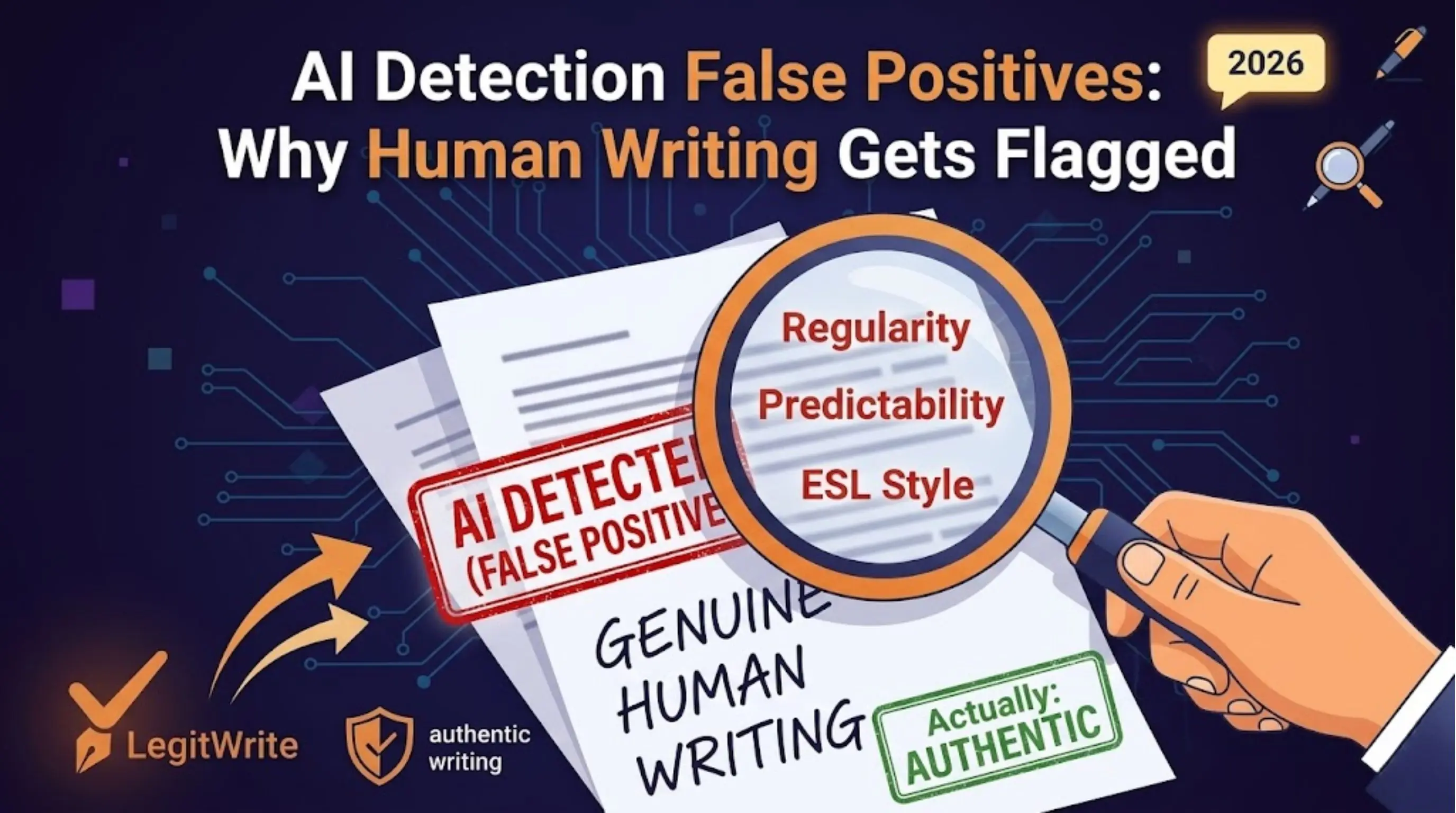
If you understand why that overlap happens, the whole topic becomes less mysterious. It also becomes easier to respond intelligently when a detector gets it wrong.
For a broader look at why schools are rethinking detector-only enforcement, read why universities are banning AI detectors in 2026.
What a false positive actually is
A false positive happens when a detector classifies genuinely human-written content as likely AI-generated.
That does not mean the detector is "broken" in a simple sense. It means the detector is using statistical cues that are imperfect proxies for authorship.
The detector sees:
- predictability
- structural regularity
- sentence uniformity
- smoothness of flow
and interprets them as AI-like.
The problem is that human writers can produce those same features too.
Why detectors make this mistake
AI detectors are solving a hard problem with incomplete evidence. They are not looking at:
- your drafting history
- your notes
- your browser tabs
- your thought process
They are looking only at the final text. From that text alone, they try to infer whether the writing process was human or machine-led.
That inference can fail when a human writes in a way that statistically resembles AI output. This is the core source of false positives.
The types of human writing most likely to get flagged
False positives are not distributed evenly. Some writing profiles are much more vulnerable.
| Writing profile | Why it is more likely to be flagged |
|---|---|
| ESL writing | often grammatically correct but structurally predictable |
| academic prose | formal, careful, and transition-heavy |
| formulaic assignments | repeated structure across many student papers |
| highly edited professional copy | polished and low-variance phrasing |
| short texts | too little context for the detector to judge reliably |
This is why the question is not just "How accurate is the detector?" but "Accurate for whom?"
ESL and international writers face a special risk
Non-native English writers are one of the groups most exposed to false positives.
Why? Because ESL writing often aims for:
- grammatical safety
- clear sentence structure
- simpler syntax
- less idiomatic variation
Those are understandable choices. But they also create prose that can look statistically similar to AI-generated text.
That does not mean ESL writing is low quality. It means detector logic often confuses clarity and predictability with machine authorship.
Academic writing is also vulnerable
Academic prose naturally includes:
- formal register
- structured transitions
- careful claim hedging
- repeated technical terminology
These features are common in human scholarship. They are also close to what many detectors treat as AI-like when the variation level is low.
So a student can write an entirely honest paper and still produce a score that looks suspicious simply because the assignment rewards a predictable academic voice.
Short documents are especially unreliable
Detectors perform best when they have more text. On very short submissions, the signal is weaker and noise matters more.
This is why false positives often appear in:
- discussion posts
- short reflections
- cover letters
- abstract-style summaries
- assignment introductions
A brief text may be too small to establish reliable variation patterns, so the detector overreacts to a few smooth sentences.
What false positives feel like in practice
A false positive usually creates one of two scenarios.
Scenario 1: the writer panics and over-defends
They see a high score and assume the software must be right. This can lead to fear-driven rewriting that actually damages the writing.
Scenario 2: the reviewer trusts the number too much
An instructor, editor, or manager treats the score like evidence of intent instead of evidence of statistical similarity. That is where false positives become consequential.
The emotional cost is real. Honest writers end up feeling accused by software that cannot actually know how the draft was produced.
What to do if your human writing gets flagged
The right response is not just "argue with the score." It is to build context around the score.
1. Save evidence of your drafting process
Helpful materials include:
- outlines
- research notes
- document history
- earlier drafts
- screenshots or revision logs
These show process rather than just outcome.
2. Identify why the text may look AI-like
Look for:
- repetitive sentence length
- overused transitions
- overly polished generic summaries
- low stylistic variation
If those are present, the issue may be structural predictability rather than actual AI use.
3. Revise the high-risk sections
False positives often concentrate in:
- introductions
- conclusions
- summary-heavy paragraphs
- formal explanatory passages
Revising those sections for more natural rhythm can reduce the score without changing the meaning.
Why synonym swapping is not the answer
When people get falsely flagged, they often rush into paraphrasing tools. That can make things worse because:
- the core structure remains similar
- the text may become less precise
- awkward word choices can appear
- the document may still read as statistically uniform
If the problem is false positive risk, the better solution is structural variation, not cosmetic substitution.
A better way to interpret detector results
The healthiest view is this:
- low score does not prove innocence
- high score does not prove guilt
- medium score especially requires interpretation
Detectors are strongest as triage tools. They are weakest when treated like final judges.
This is true for Turnitin, GPTZero, Originality.ai, ZeroGPT, and nearly every other major detector in the market.
What this means for teachers and reviewers
If you use AI detectors, false positives are not a side issue. They are one of the main operational realities.
That means good review practice should include:
- reading the flagged sections
- comparing against prior writing where possible
- allowing process evidence
- avoiding one-number conclusions
The more rigid the interpretation, the more likely it is that honest writers get harmed by probabilistic software.
Final takeaway
Human writing gets flagged because AI detectors measure resemblance, not authorship. When human prose becomes too smooth, too regular, or too statistically predictable, it can overlap with the patterns detectors associate with machine generation.
That is not fair in an emotional sense, but it is understandable in a technical sense. Once you understand that, the path forward becomes clearer: preserve meaning, increase natural variation, and avoid trusting detector scores as if they were proof.
If you are dealing with flagged writing that is genuinely yours, LegitWrite's Originality.ai vs LegitWrite comparison and related humanization workflows are a useful next step because they focus on the structural patterns detectors score rather than empty synonym swapping.
False positives are not imaginary. They are one of the central reasons AI detection still requires human judgment.