
Undetectable AI Review 2026: Does It Actually Work?
Undetectable AI is one of the best-known brands in the AI humanizer category. If someone searches for a tool that can make AI writing sound less machine-generated, there is a good chance Undetectable AI appears somewhere in the results, in YouTube reviews, or in affiliate roundups.
That visibility creates a natural assumption: if it is everywhere, it must be one of the strongest tools. Sometimes that is true. Sometimes it just means the brand won the distribution game early.
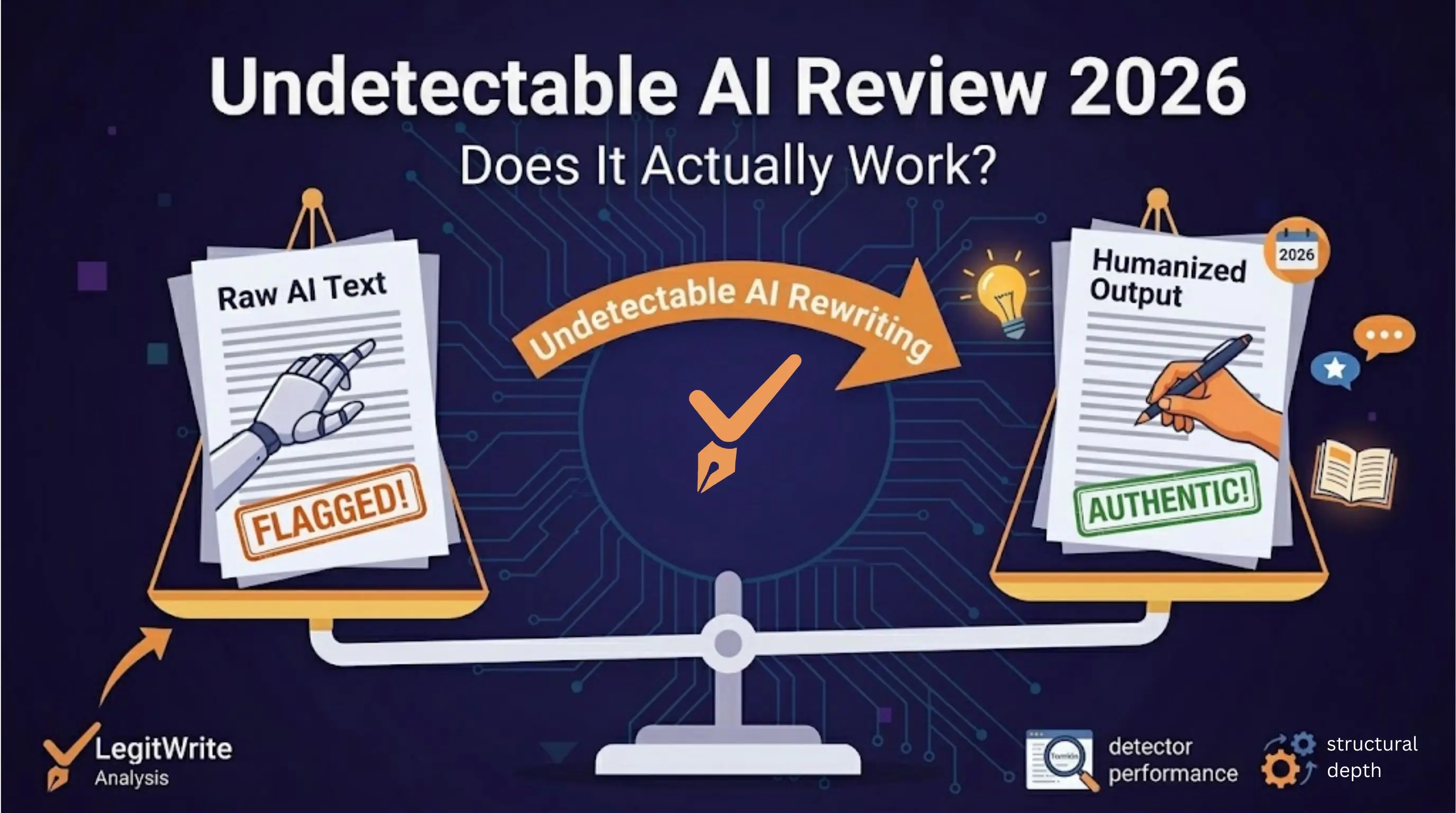
This review focuses on the question most users actually care about in 2026: does Undetectable AI produce output that is good enough for real use, not just marketing claims?
Quick verdict
Undetectable AI is competent for low- to mid-stakes rewriting. It is less convincing when the text needs to survive stronger AI detection or preserve precise academic and technical meaning.
| Category | Verdict |
|---|---|
| Ease of use | Strong |
| Output readability | Good |
| Structural rewriting depth | Mixed |
| Academic safety | Moderate at best |
| Meaning preservation | Inconsistent on dense or technical text |
So yes, it works in the narrow sense that it rewrites text and can reduce some detector scores. No, it is not the strongest option if your use case is high-stakes academic or formal content.
What Undetectable AI does well
It is easy to understand immediately
Undetectable AI has a straightforward value proposition. Paste text, run it through the tool, and receive a rewritten version designed to look more human.
That simplicity matters because most users are not looking for a complicated editing environment. They want:
- speed
- low friction
- visible before/after results
Undetectable AI generally performs well on that front.
It can improve surface fluency
For casual content such as:
- blog intros
- simple landing page copy
- short marketing blurbs
- generic product descriptions
the tool often makes the text sound less obviously AI-generated at first glance. The wording becomes less repetitive and the prose can feel more varied than raw model output.
It fits low-intent, fast-turnaround workflows
If a user wants a fast rewrite for content that will not face strict academic or institutional review, Undetectable AI can be serviceable. That is why it continues to get traction in general web content conversations.
Where Undetectable AI starts to struggle
It often rewrites the surface more than the structure
This is the biggest limitation.
The strongest AI detectors in 2026 are looking at:
- predictability
- burstiness
- sentence-level regularity
- paragraph rhythm
Undetectable AI often changes wording and clause arrangement without fully rebuilding those deeper structural signals. The text looks rewritten, but the fingerprint is not always meaningfully transformed.
It can drift on meaning
This is especially noticeable when the input includes:
- technical definitions
- academic nuance
- dates and figures
- precise qualifications
- citation-dependent claims
A sentence may come back smoother but less exact. For casual content, that may be acceptable. For essays, research writing, compliance text, or serious comparisons, it is a real problem.
The output can sound uniformly polished
One of the quieter tells in some humanizer tools is over-polish. Everything becomes smooth. Every sentence lands cleanly. Every transition is elegant. Ironically, that can still feel artificial.
Human writing usually includes variation in pressure, pace, and emphasis. Some Undetectable AI outputs still feel like they were generated by a system trained to avoid awkwardness at all costs.
Best use cases for Undetectable AI
Undetectable AI is most useful when the content is:
- relatively short
- non-technical
- low-risk
- primarily meant for web readability
Examples:
- SEO support content
- listicles
- general marketing copy
- short educational blurbs
In these contexts, "good enough" rewriting may be enough. The goal is often not perfect authorship texture, but lower friction and more natural flow.
Worst use cases for Undetectable AI
It becomes much less convincing when the content is:
- an academic paper
- a detector-sensitive essay introduction
- a citation-heavy passage
- a policy or compliance document
- a high-stakes comparison where wording precision matters
In these contexts, users need more than a softer paraphrase. They need reliable structural rewriting and stronger meaning control.
How it compares to deeper humanizers
The cleanest way to review Undetectable AI is to compare its philosophy, not just its interface.
| Approach | What it prioritizes |
|---|---|
| Paraphrase-led humanizer | surface difference, quick readability gains |
| Structural humanizer | rhythm, predictability, deeper detector-facing changes |
Undetectable AI leans closer to the first category. That does not make it useless. It just places a limit on where it is strongest.
Users often get frustrated when they evaluate it against a standard it was not built to meet. If the expectation is "make this web paragraph less robotic," it may perform fine. If the expectation is "make this Turnitin-sensitive essay section structurally human," the bar is much higher.
Does it actually work against detectors?
The honest answer is uneven.
It can reduce scores on weaker or more inconsistent detectors. It may also improve borderline passages that were only lightly AI-like to begin with.
But the more sophisticated the detector and the more machine-like the original draft, the less reliable simple humanization becomes. That is where users discover the difference between:
- a tool that rewrites text
- a tool that rewrites the underlying AI signal
This is the central divide in the category.
Pricing and value perspective
Undetectable AI's value depends on whether you judge it by:
- convenience
- depth
- precision
- detector performance
If convenience is your main metric, it remains attractive.
If precision and structural depth are your main metrics, the value becomes harder to justify because several newer tools now aim more directly at the actual signals detectors measure.
Who should use it?
Undetectable AI is a decent fit for:
- bloggers testing AI-assisted copy
- marketers refining short-form content
- users who want a familiar brand and simple workflow
It is a weaker fit for:
- students submitting through Turnitin
- writers working with dense technical content
- teams that need exact meaning preservation
- anyone relying on a rewrite alone to handle serious detector scrutiny
Final assessment
Undetectable AI still works, but its usefulness depends heavily on your expectations.
If you expect a fast, polished rewrite for low-stakes content, it can do the job. If you expect deeper structural transformation for serious detector-facing use cases, its limits become much clearer.
That is why the best way to think about it in 2026 is not "good or bad," but good for what?
If you want a direct comparison against a more structure-focused alternative, LegitWrite's Undetectable AI vs LegitWrite breakdown explains where the two approaches differ and which one fits academic, editorial, and high-stakes content better.
Brand recognition matters. But in this category, output quality matters more than brand familiarity. That is where any serious review has to end.