
Does Turnitin Detect ChatGPT? What It Actually Scores
Turnitin added AI detection to its platform in April 2023. Since then, the question students ask most is simple: does it actually work?
The honest answer is yes — but not in the way most people assume. Turnitin does not read your writing the way a professor does. It doesn't recognise ChatGPT's "voice" or flag specific phrases. What it does is far more technical, and understanding exactly how it works is the first step to knowing what puts you at risk.
How Turnitin's AI Detector Actually Works
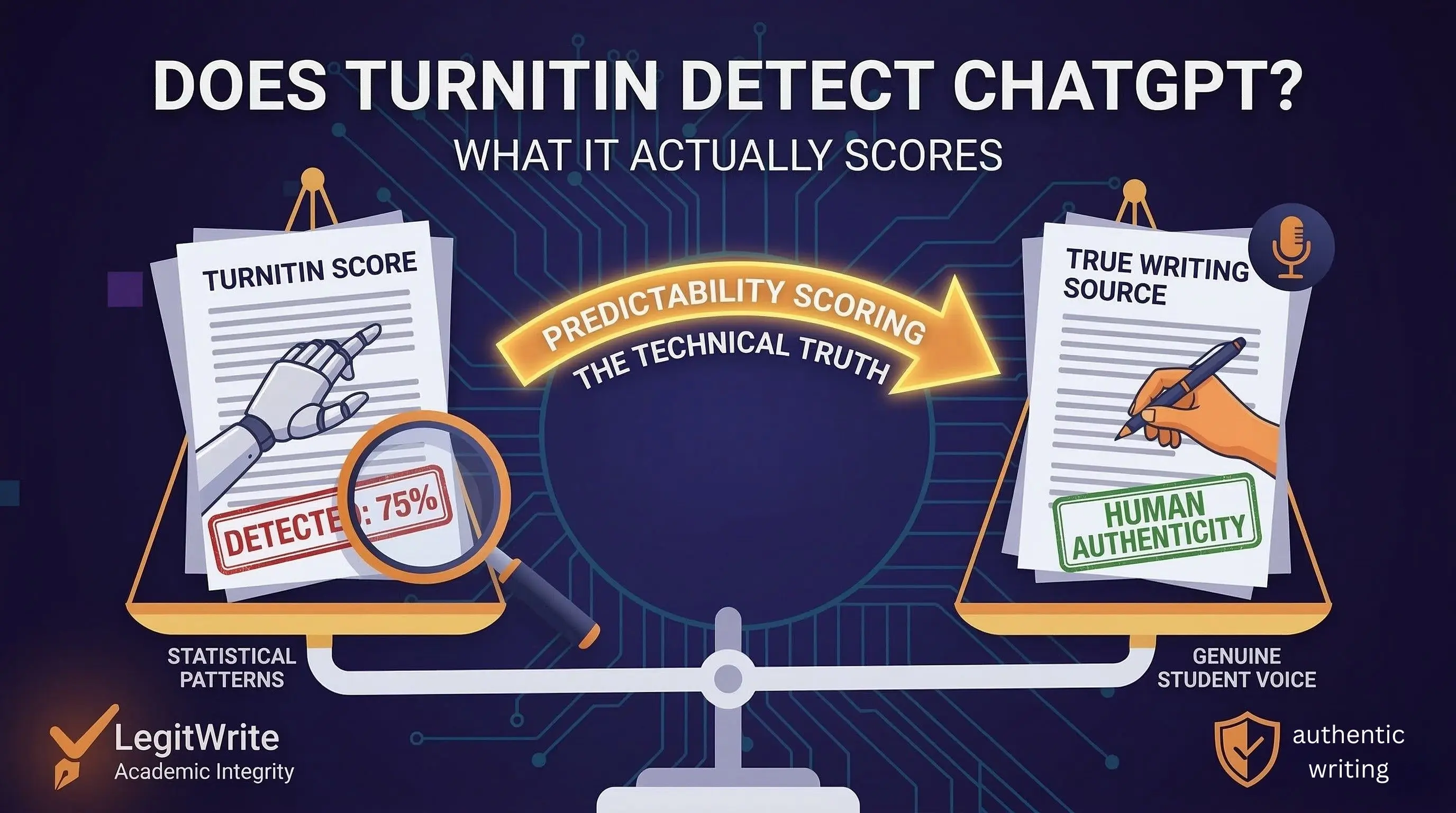
Turnitin's AI detection model is built on a concept called predictability scoring. Every word in a sentence has a probability of appearing in that position given the words before it. Human writers make surprising, idiosyncratic word choices — we deviate from the most probable path constantly. AI models, by design, tend to select high-probability word sequences because that's how they're trained to produce fluent text.
Turnitin measures what percentage of your text falls into that high-probability zone. The higher the percentage, the more the writing pattern resembles machine-generated output.
This is why simply swapping synonyms doesn't fool it. The word choices change but the underlying sentence structure, rhythm, and progression logic often stay the same — and that's what the model is actually measuring.
What Score Does Turnitin Give?
Turnitin reports AI detection as a percentage — specifically, the percentage of the submitted text that its model believes was AI-generated. A document might come back as 0%, 34%, 78%, or 100% AI-written.
Crucially, Turnitin does not set a pass/fail threshold itself. The percentage is reported to the instructor, who decides what to do with it. This means there is no universal "safe" score — a 20% flag might be ignored at one institution and investigated at another.
What Turnitin does say publicly is that its model is calibrated to produce very few false positives at higher thresholds. A 90%+ score is considered high-confidence. A score between 20% and 60% is more ambiguous and typically requires instructor judgement.
What Triggers a High Score?
Several specific patterns consistently push scores higher:
Uniform sentence length. ChatGPT tends to produce paragraphs where sentences are roughly the same length and complexity. Human writing naturally varies — short punchy sentences, longer analytical ones, fragments for emphasis. Uniformity is a strong signal.
Perfect transitions. Phrases like "Furthermore," "In addition," "It is worth noting that" appear at high rates in AI-generated academic writing. They're grammatically correct but statistically overrepresented compared to how humans actually write.
Zero hedging or personal stake. Human academic writing includes uncertainty, qualification, and personal framing. AI-generated text tends to make declarative statements without the natural hedging that appears in genuine analytical writing.
Symmetrical paragraph structure. If every paragraph in your essay has exactly the same shape — claim, evidence, explanation, transition — the structural regularity itself becomes a signal.
Absence of false starts or revision traces. Real writing has minor inconsistencies that reflect genuine thinking. AI output is uniformly polished in a way that doesn't occur naturally in human drafts.
Does Turnitin Flag Paraphrased ChatGPT?
This is where it gets nuanced. Light paraphrasing — running ChatGPT output through a basic synonym replacer — typically does not meaningfully reduce the score. The predictability patterns survive surface-level word changes.
Heavier rewriting that changes sentence structure, breaks up paragraph rhythm, introduces genuine personal analysis, and varies the logical flow can reduce a score significantly. But at that point, the question becomes how much of the original AI output is actually left.
What Turnitin cannot reliably detect is text that has been structurally rewritten — where the ideas from an AI draft have been rebuilt from scratch in the writer's own voice, using the AI output only as a reference point rather than a template.
The 20% Rule — What Is It Really?
You may have seen references to a "20% rule" or "30% rule" suggesting there's a safe threshold below which Turnitin won't act. This is a misconception.
These numbers come from individual institutional policies, not from Turnitin itself. Some universities have published guidelines saying scores below a certain threshold won't be escalated. But these are local policies, not a universal standard, and they vary enormously between institutions.
The only reliable source for what threshold applies to you is your own institution's academic integrity policy or a direct question to your instructor.
False Positives: Can Turnitin Flag Human Writing?
Yes, and this is a real and documented problem. Turnitin has publicly acknowledged that its detector can produce false positives, particularly for:
- Non-native English speakers, whose writing patterns can resemble AI output statistically
- Highly formal academic writing styles that mirror the structured output AI produces
- Technical or scientific writing with standardised phrasing conventions
- Short submissions where the sample size is too small for reliable detection
Turnitin's own guidance recommends that instructors treat AI detection scores as one signal among many, not as definitive proof of misconduct. A high score alone is not sufficient evidence of AI use under most academic integrity frameworks.
What Actually Reduces Your Detection Risk
The most effective approach is not to outsmart Turnitin's algorithm — it is to write in a way that genuinely reflects your own thinking.
Practical steps that make a real difference:
Write your own first draft, even a rough one. A rough human draft, however imperfect, establishes your natural rhythm. If you then use AI to refine specific sections, the underlying structure remains yours.
Vary your sentence length deliberately. Read your final draft out loud. If it sounds like a robot — uniform, flowing, perfectly structured — break it up. Add a two-word sentence. Start a paragraph with a question. Let a thought run longer than it needs to.
Add specific detail that only you know. Concrete examples, references to specific lectures, your own analysis of a particular source. These are not things AI can generate because they come from your direct experience.
Use AI for feedback, not output. Asking AI "what's weak about this argument?" keeps you in the author seat. Asking it to "write this section" hands the authorship over.
Run your draft through a detector before submitting. Tools like LegitWrite's AI Detector will show you exactly which sections score high and why, giving you a chance to revise before Turnitin sees it.
Summary
| What Turnitin measures | Predictability of word and sentence patterns |
|---|---|
| What it reports | A percentage of text estimated as AI-generated |
| Who sets the threshold | Your institution, not Turnitin |
| Does paraphrasing fool it | Light paraphrasing: usually no. Structural rewriting: often yes |
| Can it produce false positives | Yes, documented — especially for non-native speakers |
| What actually reduces risk | Writing with genuine voice, varied structure, personal analysis |
Turnitin's AI detector is a real tool with real detection capability. But it is not infallible, it does not set its own thresholds, and it is measuring statistical patterns — not intent, not intelligence, not whether you engaged with the material.
The best protection against a high score is writing that genuinely sounds like you. That's not a trick. It's just good writing.
Muhammad Awais is a writer and blogger covering AI tools, academic integrity, and content authenticity. Follow on Medium.
Want to check your document before submitting? Try LegitWrite's free AI Detector — no signup required for your first scan.