
Can Professors Tell If You Used ChatGPT? 7 Signs They Notice
Students often frame this question as if professors have some kind of sixth sense. They do not. Most professors cannot simply "feel" ChatGPT in a paper with perfect certainty.
But that does not mean they are guessing blindly either. Professors notice patterns. They know what your class writes like, what your earlier submissions looked like, and what kinds of errors humans usually make. When a draft suddenly becomes smoother, flatter, and more generic at the same time, suspicion starts there long before any detector score enters the conversation.
That is also why some schools are becoming more careful about automated scores. See our breakdown of why universities are banning AI detectors in 2026 for the false-positive and human-review context.
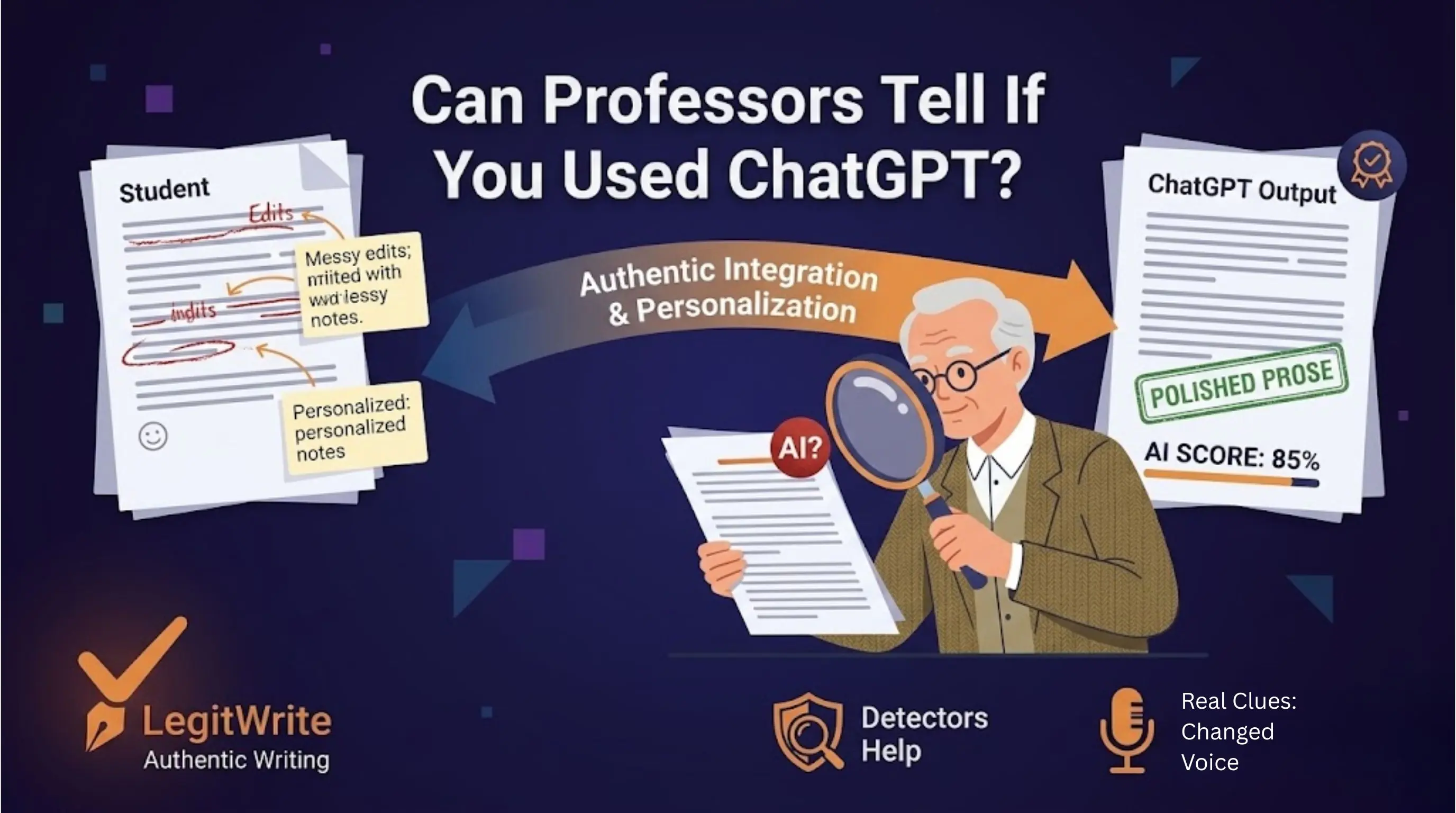
So the real answer is: yes, professors can sometimes tell, but usually not because they are identifying ChatGPT directly. They are identifying mismatch.
The short answer
| Question | Honest answer |
|---|---|
| Can professors always tell? | No |
| Can they sometimes tell? | Yes, especially when the paper sounds unlike the student |
| Do they rely only on detectors? | No, many rely heavily on judgment and comparison |
| Can a detector-free suspicion still happen? | Absolutely |
The most common trigger is not a specific AI phrase. It is the gap between the paper and the student's known level, voice, or process.
What professors notice first
Professors often notice a draft before they investigate it. Common signals include:
- a sudden jump in fluency without a similar jump in depth
- generic but polished explanations
- perfect paragraph balance
- vague confidence without real engagement
- citations that appear to support claims more cleanly than the student's analysis actually does
In other words, the paper sounds finished but not fully thought through.
That combination is deeply familiar to instructors now.
Why mismatch matters more than perfection
Students often assume that "good writing" is what gets flagged. That is not quite right. The issue is usually unearned consistency.
Imagine a student who normally:
- writes short paragraphs
- makes a few grammar mistakes
- struggles with transitions
- argues in a direct, practical style
Then suddenly submits a paper that:
- uses uniformly polished academic phrasing
- has no rough edges at all
- summarizes literature elegantly
- sounds detached from the student's earlier voice
Even if the content is not obviously AI-generated, the shift itself becomes suspicious.
Do professors use Turnitin and GPTZero?
Some do. Some do not. And even when they have access, detectors are rarely the whole story.
A professor might use:
- Turnitin AI scores
- GPTZero checks
- plagiarism reports
- in-class writing comparisons
- drafts, outlines, or revision history
- a follow-up conversation with the student
That means students sometimes misunderstand the risk. They think, "If I can get past the detector, I am safe." In reality, detector scores are often only one part of the review.
What makes ChatGPT-written work stand out to humans
Human readers often notice different clues than detectors do.
1. The paper says many correct things but feels strangely generic
This is one of the strongest tells. The prose sounds informed, but the paper avoids sharp prioritization or genuine insight.
2. It over-explains obvious ideas
AI often spends too much time sounding comprehensive. Human students, especially under deadline pressure, usually write more selectively.
3. It uses polished transition language too consistently
Phrases like:
- "it is important to note"
- "moreover"
- "in conclusion"
- "a key factor to consider"
are not wrong. They are just overrepresented in AI-assisted academic prose.
4. It lacks the student's usual texture
A professor who has read multiple assignments from the same student often knows what their natural decision-making sounds like on the page.
Can professors prove it from style alone?
Usually not conclusively. Style alone rarely proves authorship. But it can create enough concern to justify deeper review.
That deeper review may involve:
- asking for notes or drafts
- comparing with earlier submissions
- asking the student to explain an argument verbally
- requesting an in-person writing sample
This is why the student question should not be "Can they prove it instantly?" It should be "Can they become suspicious enough to investigate further?" The answer to that is clearly yes.
What about heavily edited AI writing?
This is where things get more complicated.
If a student uses AI as a starting point but then genuinely rewrites:
- the sentence rhythm
- the paragraph structure
- the argument framing
- the wording of key claims
- the introduction and conclusion
the final draft may not feel obviously AI-generated anymore. At that point, the professor may not be able to tell because the work now carries more authentic human structure.
That is different from merely prompting ChatGPT and lightly cleaning the output.
False positives exist too
There is another side to this conversation: sometimes professors suspect AI when the student really did write the paper.
This happens more often when:
- the writing is formal but highly predictable
- the student is ESL and writes in a correct but simplified structure
- the assignment format is rigid
- the student got outside editing help but not AI generation
So suspicion is not proof. It is a signal that can be wrong in either direction.
What students should do if they are worried
The best protection is not panic. It is process.
Keep evidence of your drafting
Useful materials include:
- outlines
- rough notes
- version history
- annotated readings
- partial drafts
These make it easier to show authorship if questions arise.
Rewrite high-risk sections yourself
If AI helped generate the draft, the sections most worth rewriting manually are:
- introduction
- thesis framing
- topic sentences
- conclusion
These are the places where AI most often sounds suspicious to both detectors and humans.
Make the paper yours, not just cleaner
Human writing usually shows prioritization, unevenness, and a point of view. Add:
- specific examples
- sharper phrasing
- your own framing of the issue
- your own structure choices
That matters far more than running the text through a synonym tool.
So can professors tell?
Sometimes yes. Sometimes no. But they do not need perfect certainty to start asking questions.
That is the important truth students usually miss.
Professors are not looking for a secret watermark. They are looking for:
- mismatch
- generic polish
- unsupported fluency
- a voice that does not feel owned
When those things show up together, suspicion grows quickly.
What to do next
If your concern is not just "getting past a detector" but making AI-assisted writing actually sound like a real student draft, you need structural revision, not cosmetic paraphrasing.
LegitWrite's humanize AI text for students page is built for that exact problem: preserving your meaning while reducing the machine-like patterns that both professors and detectors tend to notice first.
The safest answer to the original question is this: professors can sometimes tell if you used ChatGPT because the writing feels unlike you. The best fix is to make the writing genuinely yours.