
Does Originality.ai Have False Positives? (And What To Do About It)
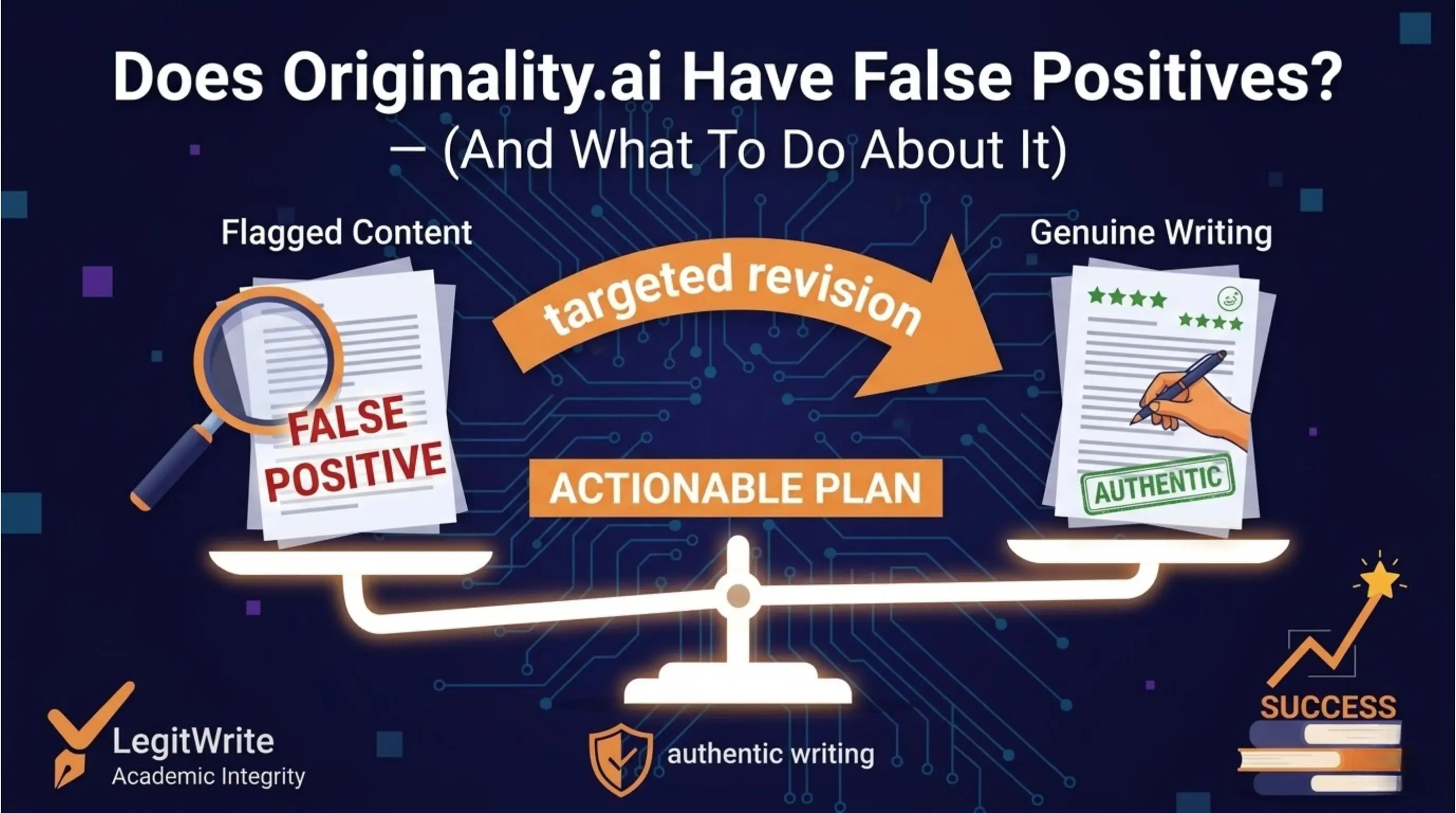
If you've submitted genuinely human-written content and watched Originality.ai return a high AI score, you're not imagining things. False positives are a documented, real, and frustrating problem with every AI detector on the market — including Originality.ai.
This isn't a fringe edge case. It happens regularly enough that content teams, writers, and academics are building workflows specifically to deal with it. Understanding why it happens, who is most at risk, and what you can actually do about it is the difference between a panic and a plan.
What Is a False Positive in AI Detection?
A false positive occurs when an AI detector flags human-written content as AI-generated. The detector isn't lying — it's doing exactly what it's designed to do. The problem is that what it's measuring (statistical patterns in text) doesn't perfectly map onto what we actually care about (whether a human wrote it).
Originality.ai, like all current AI detectors, works by comparing your text against probabilistic models of how AI language models generate text. If your writing pattern overlaps statistically with how GPT-4 or Claude writes, the detector will flag it — regardless of whether you wrote every word yourself at 2am with a coffee in your hand.
How Common Are False Positives on Originality.ai?
Originality.ai has been tested extensively by content agencies and independent researchers. The consensus findings are:
- Originality.ai is more aggressive than most detectors — it's calibrated to catch AI content in professional content marketing contexts, where the cost of missing AI content is considered higher
- Its false positive rate on genuinely human content ranges from roughly 2% to 8% in controlled tests, depending on writing style
- For certain writing profiles (see below), the false positive rate climbs significantly higher
The company itself acknowledges that no detector achieves 100% accuracy and recommends human review alongside automated scoring.
Who Gets Flagged Most Often
Not all human writers are equally at risk. Originality.ai's false positive rate is significantly higher for:
Non-native English writers. Writers whose first language isn't English often produce grammatically correct but structurally predictable prose — shorter sentences, simpler syntax, less idiomatic variation. This pattern overlaps with AI output more than native writing typically does.
Highly trained academic writers. Academic writing has conventions: formal register, hedged claims, structured argumentation, passive constructions. These conventions make academic prose statistically more similar to AI output than casual writing.
Writers in technical niches. Technical content — SaaS documentation, medical writing, legal copy — uses standardised phrasing that appears at high rates in AI training data. Originality.ai can struggle to distinguish between a human following industry conventions and an AI doing the same.
Writers who edit heavily. Paradoxically, polished writing scores higher than rough writing. Heavy editing removes the natural inconsistencies and variations that signal human authorship. A very clean, very tight draft can look more AI-like than a first draft with its rough edges intact.
Writers covering AI topics. If you write about AI tools, AI detection, or related topics, you're using vocabulary and sentence patterns that appear at extremely high rates in AI-generated content about those same topics. The subject matter itself creates statistical overlap.
Why Originality.ai Flags Clean Writing
The core reason clean, well-structured writing gets flagged is that AI models are trained to produce exactly that — clean, well-structured writing. The statistical fingerprints of quality overlap with the statistical fingerprints of machine generation.
This is the fundamental tension in AI detection that no current tool has fully solved. The better a human writes in a formal register, the more their writing resembles what a well-prompted AI produces.
Originality.ai uses a combination of signals including perplexity (how surprising word choices are), burstiness (how much sentence length varies), and pattern matching against known AI output distributions. When your writing scores low on perplexity and low on burstiness — because you write clearly and consistently — the combined signal points toward AI even when it shouldn't.
Seeing a high score on your own content? Run it through LegitWrite's AI Detector — it breaks down exactly which sections are flagging and why, so you know where to focus your revisions.
What To Do If Your Human Content Gets Flagged
Getting a false positive is frustrating, but it's not the end of the conversation. Here's a structured response:
Step 1: Don't panic and don't immediately rewrite everything.
Rewriting content in response to a false positive often makes things worse. If you start optimising for the detector's output rather than for clarity and accuracy, you risk producing writing that's worse for readers and still gets flagged anyway.
Step 2: Identify the specific sections triggering the flag.
Originality.ai highlights the sections it believes are AI-generated. Look at those sections specifically. Is the sentence structure unusually uniform? Are the transitions formulaic? Is the paragraph rhythm repetitive? If you can see why the detector is flagging it, you can make targeted revisions.
Step 3: Introduce genuine variation.
The most effective revision approach is to introduce natural variation in the flagged sections:
- Break up long uniform paragraphs with shorter punchy sentences
- Replace generic transitions ("Furthermore," "In addition") with specific connective language tied to your actual argument
- Add a concrete example, a specific data point, or a personal observation that only you could write
- Let one sentence be imperfect — a slight repetition, an em dash mid-thought, a question you don't fully answer
These aren't tricks. They're the natural characteristics of human writing that got smoothed out during editing.
Step 4: Document your process.
If you're submitting to a client or an institution that uses Originality.ai, keep your drafts, notes, and sources. Process documentation is the strongest defence against a false positive accusation because it shows the work that produced the final text.
Step 5: Request a human review.
For professional content, most agencies and editors will offer a human review if you dispute an automated score. For academic contexts, most integrity policies include an appeals process that allows you to present your process as evidence.
Can You Prevent False Positives Before They Happen?
Yes — with a pre-submission workflow:
Check before you submit. Run your content through a detector before it reaches a client or institution. LegitWrite's AI Detector will show you your score and highlight the specific sections driving it, giving you time to revise on your own terms rather than in response to an accusation.
Write rougher first drafts on purpose. If you know you're a heavy editor, preserve some of the roughness. A few intentional imperfections — a varied sentence that bucks your usual rhythm, a slightly informal phrase in an otherwise formal piece — create the natural variation that detectors use to identify human authorship.
Vary your structure deliberately. If every paragraph in a piece follows the same structure, break one of them. Not for the detector's benefit — for the reader's. Structural variety is a sign of genuine thinking, and it also happens to reduce AI detection scores.
Avoid AI-adjacent vocabulary when possible. Phrases like "delve into," "it is worth noting," "in today's rapidly evolving landscape," and "leverage" appear at disproportionately high rates in AI content. If these have crept into your writing style, replacing them with more specific language helps both your score and your prose.
The Bigger Picture
False positives are a symptom of a deeper problem: current AI detection technology is probabilistic, not deterministic. It cannot read intent. It cannot verify authorship. It can only measure statistical patterns and make an educated guess.
This means false positives will continue to happen as long as:
- AI models are trained on human writing (making the two distributions overlap)
- Detection models are calibrated aggressively to catch sophisticated AI use
- Human writers in certain profiles naturally produce text that resembles AI output
The right response to this reality is not to stop caring about detection — it's to build a writing process that produces both genuinely human work and the kind of variation that detectors recognise as human.
Those two goals are not in conflict. They're the same goal.
Quick Reference: False Positive Risk Factors
| Risk factor | Why it increases false positive rate |
|---|---|
| Non-native English | Simpler syntax overlaps with AI patterns |
| Heavy editing | Removes natural variation that signals human authorship |
| Academic writing style | Formal conventions match AI training data |
| Technical niche content | Standardised phrasing appears in AI output |
| Writing about AI topics | Vocabulary overlap with AI-generated content |
| Short submissions | Too little data for reliable detection |
Muhammad Awais is a writer and blogger covering AI tools, academic integrity, and content authenticity. Follow on Medium.
Worried about a false positive on your own content? Check your score for free on LegitWrite — no signup needed for your first scan, and you'll see exactly which sections are triggering the flag.