
Can GPTZero Detect Paraphrasing? What Actually Gets Flagged
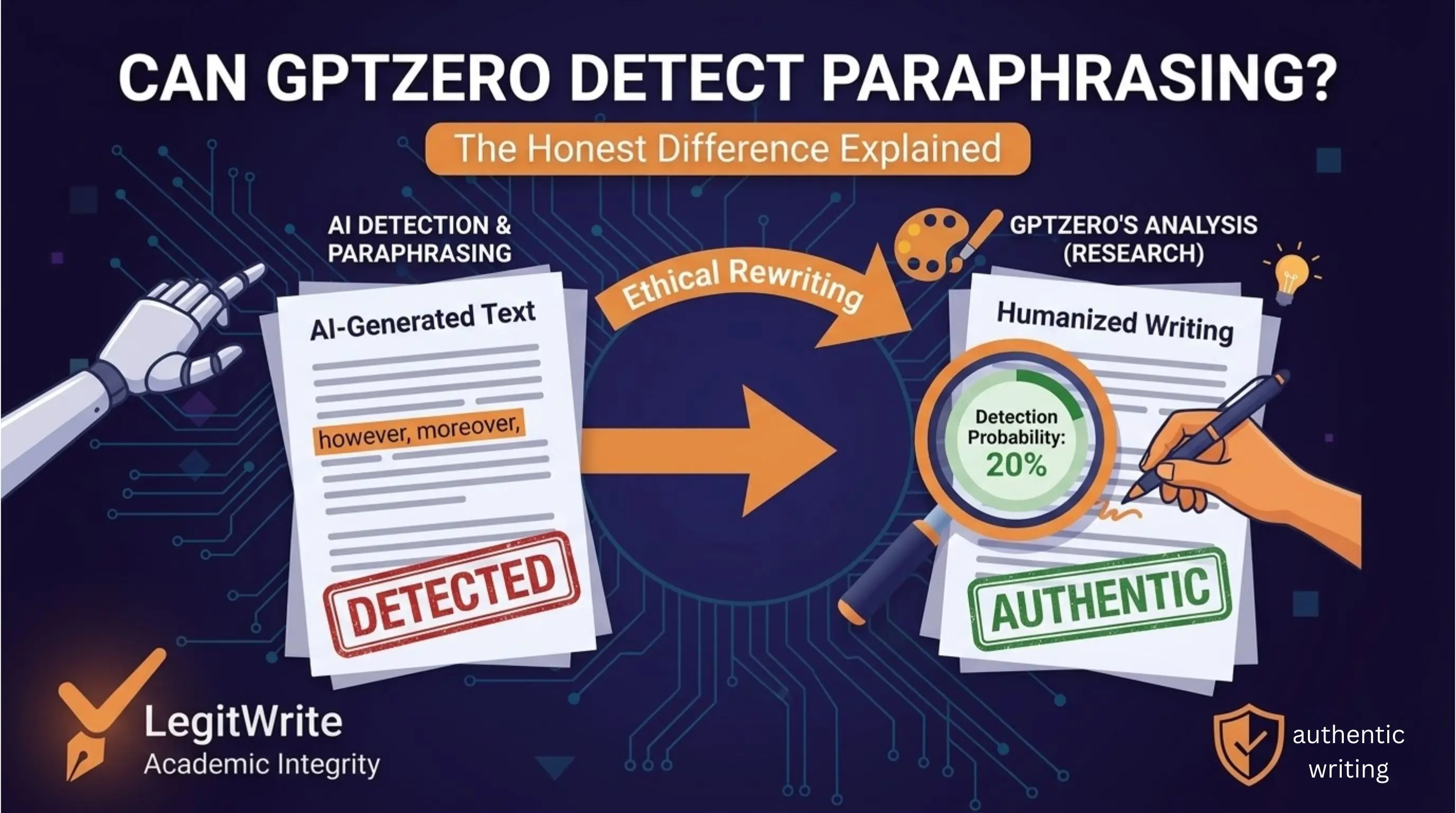
GPTZero is one of the most widely used AI detectors in academic settings. Built by Princeton student Edward Tian in 2023, it became the go-to tool for educators trying to identify AI-generated student work. But one question keeps surfacing: can it actually detect paraphrased AI content — text that started as AI output but was reworded before submission?
The research gives a clear answer, and it's more nuanced than either "yes it catches everything" or "just paraphrase and you're fine."
What GPTZero Actually Measures
Before getting into paraphrasing specifically, it helps to understand what GPTZero is actually looking at.
GPTZero uses two primary metrics:
Perplexity — how predictable the word choices are. Low perplexity means the text follows high-probability patterns, which is characteristic of AI output. High perplexity means the text made more surprising choices, which is characteristic of human writing.
Burstiness — how much sentence complexity varies throughout the document. Human writing is naturally bursty — long complex sentences followed by short punchy ones. AI writing tends to be more uniform in sentence structure and length.
GPTZero combines these signals with pattern matching against known AI output distributions to produce a sentence-level and document-level score. The sentence-level highlighting is particularly useful — it shows you exactly which sentences are driving a high score.
What Happens to These Signals When You Paraphrase?
This is the key question. When AI-generated text is paraphrased, what happens to the perplexity and burstiness scores?
The answer depends entirely on how the paraphrasing is done.
Surface-level paraphrasing — swapping synonyms, reordering clauses, changing passive to active voice — has minimal effect on GPTZero's detection. The underlying sentence structure, rhythm, and logical flow remain intact. The statistical patterns that GPTZero measures survive synonym replacement almost completely. Studies have consistently found that basic paraphrasing reduces GPTZero scores by only a few percentage points.
Structural paraphrasing — rewriting sentences from scratch with different structure, breaking up uniform paragraph rhythm, introducing varied sentence lengths — has a more significant effect. When the sentence-level architecture changes, burstiness increases and the distribution of perplexity scores shifts. GPTZero scores can drop meaningfully with genuine structural rewriting.
Deep rewriting — rebuilding content from the ground up using the AI draft only as a reference, adding specific personal knowledge, changing the argumentative structure, introducing genuine voice — can reduce GPTZero scores to the point where detection is unreliable. At this level of rewriting, the question of whether the original text was AI-generated becomes somewhat academic, because the final text is genuinely the writer's own work.
What the Research Shows
Several independent studies have specifically tested GPTZero's performance against paraphrased AI content:
A 2024 study published in Computers and Education tested GPTZero against AI essays that had been paraphrased using QuillBot, manual rewriting, and a combination of both. Key findings:
- QuillBot paraphrasing alone reduced detection accuracy from 94% to approximately 71%
- Manual structural rewriting reduced accuracy to approximately 58%
- Combined QuillBot plus manual rewriting reduced accuracy to approximately 52% — statistically close to random chance
A separate analysis by researchers at Stanford found that GPTZero's false positive rate on human-written essays by non-native English speakers was approximately 12% — significantly higher than its reported overall false positive rate, confirming that certain writing profiles are systematically disadvantaged.
GPTZero's own published benchmarks show high accuracy — above 99% in some tests — but these benchmarks are run against unmodified AI output in controlled conditions. Real-world accuracy against modified content in diverse writing contexts is considerably lower.
Does GPTZero Detect QuillBot Paraphrasing Specifically?
QuillBot is the most widely used paraphrasing tool among students. GPTZero has been specifically tested against QuillBot output, and the results are worth understanding.
QuillBot's standard paraphrasing mode makes primarily surface-level changes — synonym replacement, clause reordering, minor structural adjustments. GPTZero catches QuillBot-paraphrased AI content at significantly higher rates than manually rewritten content, because the underlying statistical patterns survive QuillBot's transformations.
QuillBot's "Creative" mode, which makes more aggressive structural changes, reduces detection rates more significantly — but also introduces a higher risk of meaning distortion, which creates a different kind of problem.
The practical conclusion: using QuillBot as a sole paraphrasing strategy against GPTZero is unreliable. It reduces scores but does not reliably bring them below detection thresholds, and it is not a substitute for genuine rewriting.
GPTZero's Own Position on Paraphrasing
GPTZero has been transparent about its limitations with paraphrased content. In public statements and documentation, the company acknowledges that:
- Detection accuracy decreases as the degree of modification increases
- Paraphrasing tools specifically designed to evade detection can reduce accuracy significantly
- GPTZero scores should be treated as indicators for further review, not as definitive proof of AI use
This is consistent with the broader industry position: no current detector can reliably catch sophisticated, heavily modified AI content with the confidence required to make high-stakes decisions.
What This Means If You're a Student
If you're a student worried about GPTZero flagging your genuine human writing, the research offers some reassurance and some practical guidance.
Reassurance: GPTZero's false positive rate on genuine human writing is low in most cases — typically under 5% for native English writers in standard academic writing contexts. A high score on genuinely human writing is possible but not common.
Risk factors that increase false positive likelihood: non-native English, heavy editing, very formal academic style, writing about AI topics, short submissions. If any of these apply to you, run your work through a detector before submitting.
What to do if you get flagged: A GPTZero score is not evidence of misconduct. It is a flag for human review. Most academic integrity processes require additional evidence beyond an automated score. Document your writing process — drafts, notes, sources — and present that process if challenged.
What This Means If You Use AI as a Writing Tool
If you use AI to help draft content and then rewrite it, the research suggests that surface-level paraphrasing is not sufficient to reliably reduce GPTZero scores. Genuine structural rewriting — changing sentence architecture, adding personal knowledge and specific detail, introducing natural variation — is both more effective at reducing scores and more defensible as a writing practice.
The distinction matters: paraphrasing is cosmetic. Rewriting is substantive. GPTZero, imperfect as it is, is better at distinguishing between these two things than most people assume.
Tools like LegitWrite's AI Humanizer are designed around substantive rewriting rather than surface paraphrasing — adjusting rhythm, tone, and structure rather than just swapping words. The result is writing that reads as genuinely human because it has been genuinely revised, not just cosmetically altered.
Summary: GPTZero and Paraphrasing
| Paraphrasing type | Effect on GPTZero score | Reliability as a strategy |
|---|---|---|
| Synonym replacement only | Minimal reduction | Unreliable |
| QuillBot standard mode | Moderate reduction | Unreliable |
| QuillBot creative mode | Larger reduction | Inconsistent |
| Manual structural rewriting | Significant reduction | More reliable |
| Deep rewriting with personal voice | Large reduction | Most reliable |
| Raw unmodified AI output | Baseline high score | N/A |
GPTZero can detect paraphrasing — specifically, it can detect paraphrasing that doesn't change the underlying statistical structure of the text. What it struggles to detect is genuine rewriting, because genuine rewriting produces text that is statistically different from the original AI output in the ways that matter.
That's not a loophole. That's just what good writing looks like.
Muhammad Awais is a writer and blogger covering AI tools, detection technology, and content authenticity. Follow on Medium.
Want to see how your writing scores on GPTZero's key metrics before you submit? Run a free scan on LegitWrite — no signup needed, instant results.