
Turnitin AI Detection: How It Works and What It Flags
Turnitin's AI detection capability launched in April 2023 and has since become the most widely used automated AI detection system in academic settings worldwide. Thousands of universities and schools now run submissions through it as a matter of routine.
If you're a student, educator, or academic writer, understanding exactly how Turnitin's AI detector works — what it measures, what it flags, and where it fails — is no longer optional background knowledge. It's practical information that affects how you write and how you respond if you're flagged.
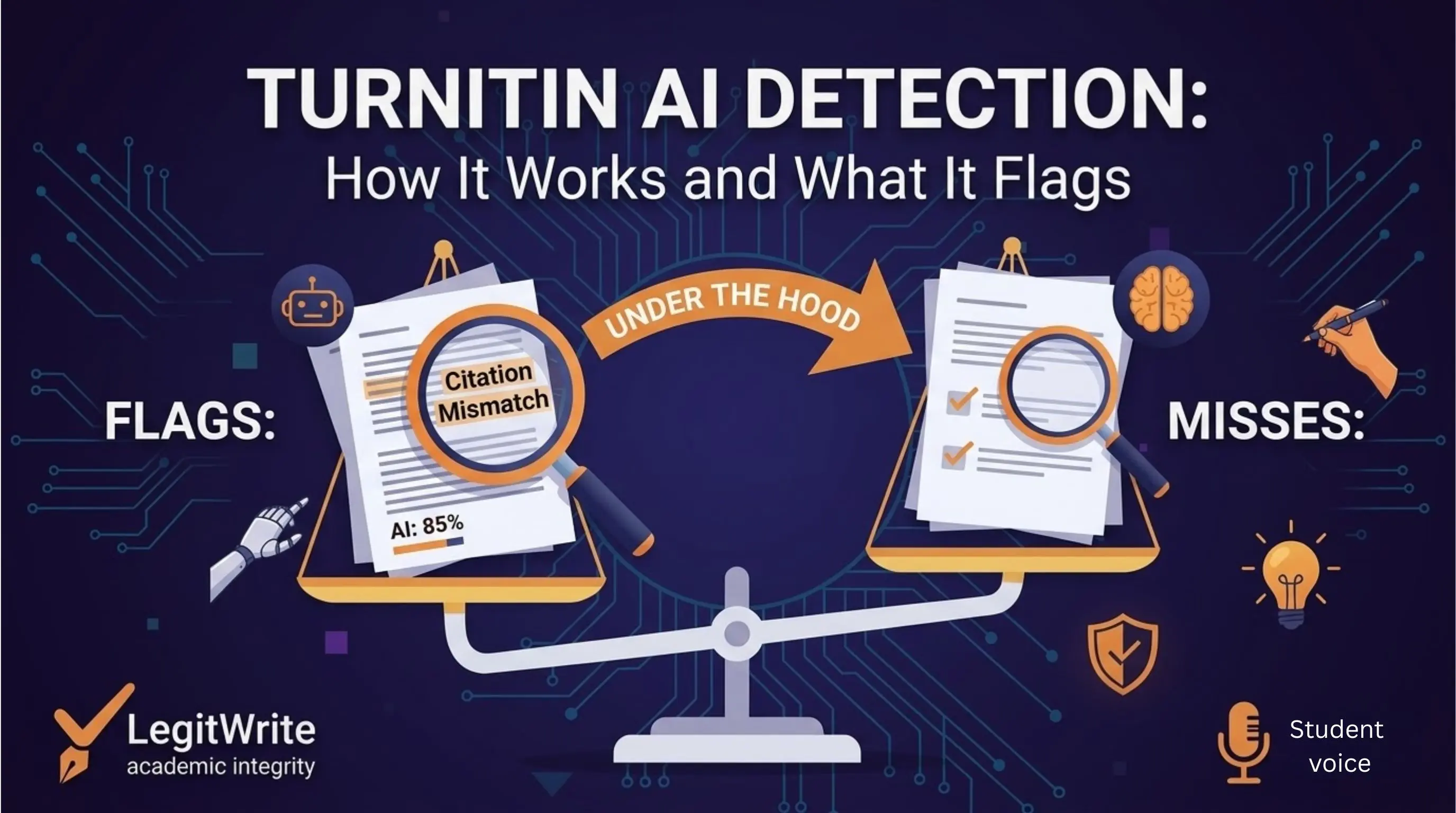
How Turnitin Added AI Detection
Turnitin's core product was originally built around plagiarism detection — comparing submitted text against a database of existing sources to identify copied content. AI detection is a fundamentally different problem that required a fundamentally different approach.
Rather than comparing text against a database, Turnitin's AI detector uses a predictive model trained on large volumes of both human-written and AI-generated academic text. The model learned the statistical differences between how humans write academic essays and how large language models like ChatGPT and GPT-4 generate them.
The result is a scoring system that analyses the probabilistic patterns in submitted text and estimates what percentage was likely generated by an AI model.
What Turnitin's AI Detector Actually Measures
Turnitin does not maintain a list of AI phrases or patterns to match against. It measures statistical properties of the text itself.
Predictability of word choices. At every point in a sentence, there is a probability distribution over what word might come next. AI models tend to select high-probability words — the statistically expected choice. Human writers deviate from this distribution more often, making more surprising, idiosyncratic choices. Turnitin measures how closely your text follows high-probability word sequences.
Sentence-level pattern consistency. AI-generated academic text tends to produce paragraphs where sentences follow predictable structural patterns — similar length, similar complexity, similar logical architecture. Human academic writing shows more variation within and across paragraphs.
Transition and connective language patterns. Certain transitional phrases appear at statistically anomalous rates in AI-generated academic writing. Turnitin's model has learned these patterns from training data and weights them accordingly.
Document-level coherence signals. How ideas develop and connect across a full document follows different patterns in AI versus human writing. Turnitin analyses the full submission, not just individual sentences.
What Turnitin Reports
Turnitin reports AI detection as a single percentage — the estimated proportion of the submitted text that its model believes was AI-generated.
The report is displayed to instructors, not students. Students typically do not see their AI detection score directly unless their institution has configured Turnitin to share it with them.
The percentage is accompanied by sentence-level highlighting that shows instructors which specific passages are driving the score. A submission might show 45% overall with specific paragraphs highlighted in blue to indicate high AI probability.
Critically, Turnitin does not set a threshold. There is no score above which Turnitin automatically flags a submission as a violation. The percentage is reported to the instructor, who decides what action — if any — to take based on their institution's policies.
What Triggers a High Turnitin AI Score
Based on Turnitin's published guidance and independent testing, these are the most reliable predictors of a high AI detection score:
Unmodified ChatGPT or GPT-4 output. Raw AI output scores extremely high — typically 90% or above — in Turnitin's system. This is the case the detector was primarily designed for and performs best on.
Uniform paragraph structure. Essays where every paragraph follows the same architecture — claim, evidence, explanation, transition — trigger structural regularity signals. Human essays almost always show some variation in paragraph approach.
Overuse of formal transitional phrases. "Furthermore," "In addition," "It is important to note," "This demonstrates that" — these phrases are not wrong in isolation but their frequency and distribution in AI-generated academic text is statistically different from their frequency in human writing.
Perfectly hedged academic language. AI models have been fine-tuned on academic writing and produce text that hedges claims appropriately, cites evidence formally, and maintains consistent register. Ironically, writing that is too academically correct can increase an AI score.
Absence of specific personal or course-related detail. Human students writing about material they've actually studied tend to include specific references — to particular lectures, to specific examples discussed in class, to their own reactions to the material. AI-generated text cannot include these because it doesn't have access to them. Their absence is a weak but real signal.
What Turnitin Does Not Flag Reliably
Understanding the limits of Turnitin's detection is as important as understanding what it catches.
Heavily revised AI output. Text that started as AI-generated but was substantially rewritten — with changed sentence structure, added personal voice, specific detail, and genuine variation — scores significantly lower. Turnitin's accuracy against genuinely revised AI content is considerably weaker than against raw output.
AI-assisted writing where the human voice dominates. If a writer uses AI to generate an outline or brainstorm ideas but writes the actual text themselves, the statistical patterns reflect the human author rather than the AI. Turnitin generally cannot detect AI involvement at this level.
Non-native English writing that mimics AI patterns. This is a known and documented problem. Writers whose first language isn't English sometimes produce structurally predictable prose that shares statistical properties with AI output. Turnitin's false positive rate is higher for this group than for native English writers.
Very short submissions. Turnitin requires sufficient text to generate a reliable statistical estimate. Short submissions — under approximately 300 words — produce less reliable scores because the sample size is too small.
Turnitin's Own Position on Its Accuracy
Turnitin has been specific about what its AI detection can and cannot do, and it's worth taking their own statements seriously.
Turnitin states that its model is designed to minimise false positives — to avoid flagging human writing as AI-generated — at the cost of potentially missing some AI content. They explicitly calibrate toward fewer false accusations rather than maximum detection.
They also explicitly state that AI detection scores should be treated as one input into an instructor's judgement, not as standalone evidence of misconduct. Turnitin's own guidance recommends that instructors consider the full context of a submission — the student's prior work, the assignment type, the specific passages flagged — before taking any action.
This is not a legal disclaimer. It reflects a genuine technical reality: a probabilistic detection system cannot produce the certainty required for high-stakes academic integrity decisions. A 90% AI score means Turnitin's model is highly confident — it does not mean the submission is definitely AI-generated.
What Happens If You're Flagged
If a submission receives a high AI detection score, the process typically unfolds like this:
The instructor receives the score alongside the highlighted submission. They decide whether the score, in context, warrants further investigation. If it does, most institutions have a formal academic integrity process that includes the opportunity for the student to respond.
At this stage, the automated score is evidence to be considered alongside other evidence — the student's other work, their ability to discuss the submission in person, any process documentation they can provide.
A high Turnitin AI score is the beginning of an investigation, not the conclusion of one. Students who can demonstrate their writing process — through drafts, notes, outlines, and sources — are in a significantly stronger position than those who cannot.
How to Reduce Your Turnitin AI Score Legitimately
The most effective approaches are also the most straightforward:
Write your own first draft. Even a rough, imperfect first draft establishes your natural writing rhythm and introduces the variation that detectors associate with human authorship. Polishing a human draft produces different statistical patterns than polishing an AI draft.
Add specific detail only you can provide. References to specific course content, your own analysis of particular sources, concrete examples from your own experience — these signals are impossible for AI to generate because they require knowledge the model doesn't have.
Vary your sentence structure deliberately. Read your draft aloud. If the rhythm is too uniform, break it. A short sentence after a long one. A question mid-argument. A paragraph that starts with evidence rather than claim. These variations are both better writing and lower detection signals.
Check before you submit. Running your work through a detector before submission gives you the chance to identify high-scoring sections and revise them on your own terms. LegitWrite's AI Detector provides sentence-level analysis similar to what Turnitin shows instructors — so you can see exactly what will flag before it reaches them.
Summary
| What Turnitin measures | Statistical predictability of word and sentence patterns |
|---|---|
| What it reports | Percentage of text estimated as AI-generated |
| Who sees the score | Instructors (students may or may not, depending on institution settings) |
| Who sets the threshold | Your institution — Turnitin does not set pass/fail cutoffs |
| Strongest detection case | Raw, unmodified AI output |
| Weakest detection case | Heavily revised AI content, non-native English writing |
| What a high score means | A flag for instructor review — not proof of misconduct |
Turnitin's AI detector is a serious tool used seriously by institutions worldwide. It is not infallible, it does not produce verdicts, and it is not the last word on whether a submission involved AI. But it is accurate enough in the right conditions that treating it as irrelevant is a mistake.
The best response to it — for students and writers alike — is the same: write in a way that genuinely reflects your own thinking, with your own specific knowledge and your own natural voice. That's not a strategy for avoiding detection. That's just what good academic writing looks like.
Muhammad Awais is a writer and blogger covering AI tools, academic integrity, and content authenticity. Follow on Medium.
Want to see your Turnitin risk before you submit? Run a free scan on LegitWrite — sentence-level analysis, no signup required.