
Does Grammarly Detect AI Writing?
Grammarly is one of the most familiar writing tools on the internet, so it makes sense that people ask whether it can detect AI writing. If you already use Grammarly for grammar, tone, and clarity, it is natural to assume it might also tell you whether a piece of text looks AI-generated.
The short answer is: Grammarly is not the tool most people should rely on as their primary AI detector.
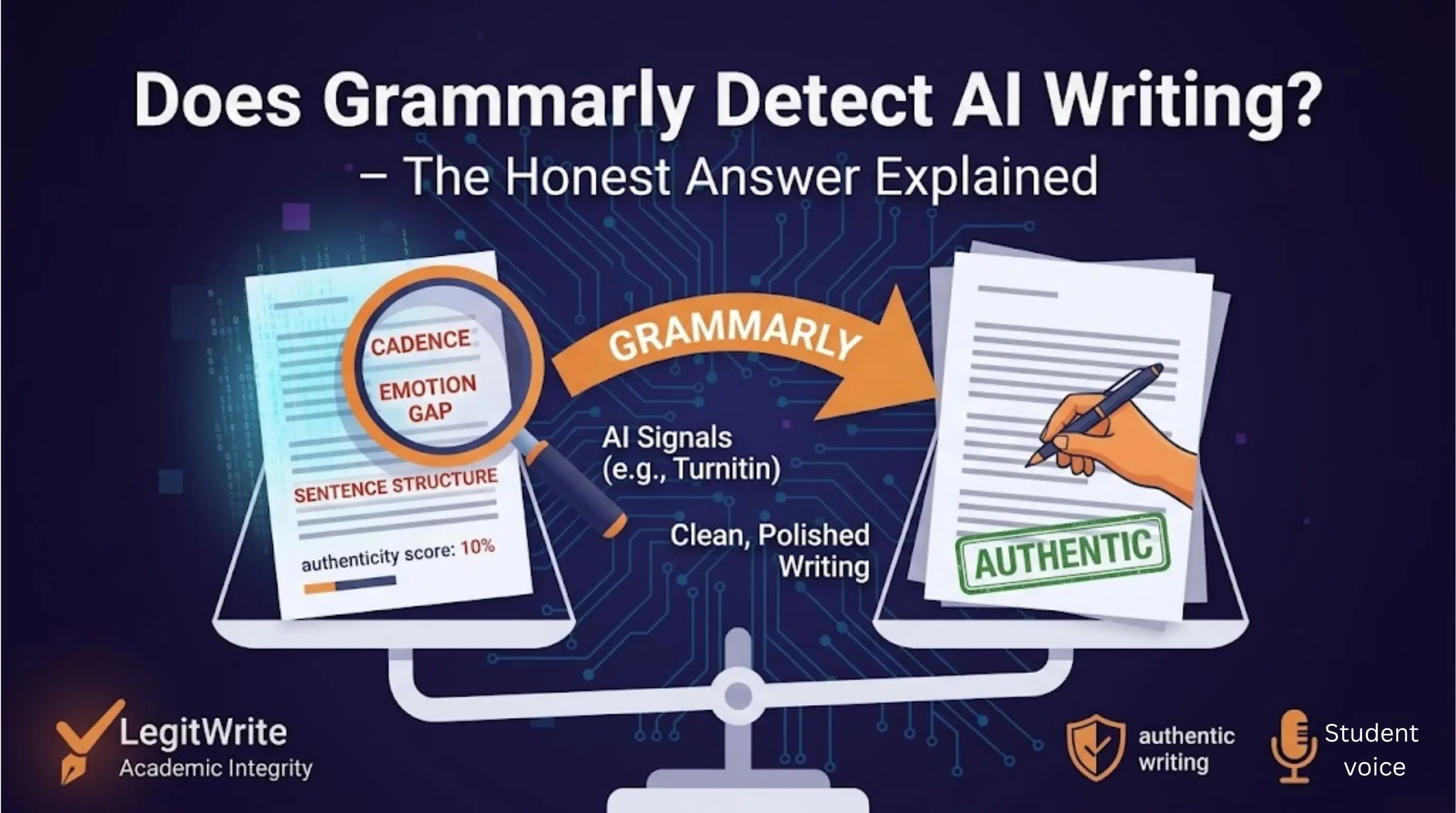
That does not mean Grammarly is irrelevant to the AI conversation. It just means people often confuse three different things:
- writing assistance
- AI generation
- AI detection
Once those are separated, Grammarly's role becomes much easier to understand.
Grammarly is mainly a writing improvement tool
Historically, Grammarly's core job has been to improve writing quality. It helps with:
- spelling
- grammar
- clarity
- tone suggestions
- sentence rewrites
- style consistency
That is different from a detector's job.
A detector tries to estimate whether text resembles machine-generated output. Grammarly, by contrast, has usually been focused on making text cleaner and more readable.
So if you open Grammarly expecting the same kind of analysis you would get from Turnitin, GPTZero, or Originality.ai, you are already comparing different product categories.
Why people assume Grammarly should detect AI
There are a few reasons this confusion is so common.
Grammarly already sits inside the writing workflow
Because Grammarly appears while people write, it feels close to the drafting process. That makes users assume it should also know whether the writing is human or AI-assisted.
Grammarly now talks openly about AI
Once Grammarly added AI-powered writing features, the assumption grew stronger: if the platform can help generate text, surely it can also identify AI-generated text.
The brand is trusted
When a company is already seen as an authority on writing quality, users extend that trust into neighboring questions, including AI detection.
That assumption is understandable, but it still needs a more precise answer.
Grammarly versus dedicated AI detectors
The most useful comparison is this:
| Tool type | Primary purpose | Examples |
|---|---|---|
| writing assistant | improve grammar, clarity, tone | Grammarly |
| detector | estimate whether text looks AI-generated | GPTZero, Turnitin, Originality.ai |
| humanizer / structural rewriter | change AI-like structure while preserving meaning | LegitWrite |
This table matters because it shows that Grammarly lives in a different lane.
Even if Grammarly offers AI-related signals or writing analytics, that is not the same as being a dedicated detector designed around authorship-risk decisions.
What Grammarly can help you notice indirectly
Even when Grammarly is not acting as a dedicated detector, it can still surface issues that overlap with AI-style writing.
For example, Grammarly may nudge users away from:
- repetitive phrasing
- bland sentence starts
- generic wording
- overly flat tone
Those are also qualities that can make text feel machine-like. So Grammarly can sometimes improve readability in ways that incidentally reduce AI-like stiffness.
But that is not the same as explicitly answering the detector question.
Improving style and measuring AI-likeness are related, not identical, goals.
Why Grammarly is not enough for high-stakes detection questions
If you are in any of these situations:
- submitting coursework through Turnitin
- reviewing agency content for publication
- trying to understand why GPTZero is flagging a piece
- worried about Originality.ai scores
then Grammarly is not the right primary tool for the job.
Why? Because high-stakes detection questions usually require:
- a direct AI-likelihood judgment
- structural pattern analysis
- detector-specific interpretation
- workflow decisions after a flag appears
Grammarly was not built around that use case.
The deeper issue: good grammar is not the same as low AI risk
One of the biggest mistakes people make is assuming cleaner writing must be safer writing. That is not always true.
In fact, extremely polished text can sometimes increase detector suspicion if it becomes:
- too smooth
- too regular
- too balanced
- too structurally predictable
This is why grammar correction alone does not solve AI detection concerns. A document can be grammatically excellent and still look statistically machine-like.
That distinction matters for students, marketers, and professionals alike.
Can Grammarly-generated suggestions make writing look more AI-like?
This is a better question than "Does Grammarly detect AI?"
If a tool aggressively smooths phrasing, equalizes rhythm, and standardizes transitions, it can sometimes move writing toward a more uniform texture. Uniformity is one of the things detectors often react to.
That does not mean Grammarly itself is a problem. It means any writing tool should be used with judgment.
The goal is not just correctness. The goal is writing that still feels natural, varied, and human.
How Grammarly differs from GPTZero and Turnitin
GPTZero
GPTZero is designed to estimate AI-likeness directly. It frames this around signals like predictability and burstiness.
Turnitin
Turnitin operates in institutional academic workflows and flags AI-like patterns as part of a broader integrity process.
Grammarly
Grammarly is mainly designed to improve the text in front of you, not to classify its authorship origin.
So if you are asking whether a submission might be flagged by a detector, Grammarly is not a substitute for those detector platforms.
When Grammarly is useful in the AI writing workflow
Grammarly still belongs in the workflow. It just belongs in a different stage.
A practical sequence might look like this:
- draft the content
- use Grammarly to clean obvious grammar or clarity issues
- review the writing for structural uniformity
- test against the relevant detector if needed
- humanize the structure if the text remains too machine-like
This sequence makes more sense than expecting Grammarly to solve all five problems alone.
What to do if your writing sounds "too AI" after editing
If a draft becomes polished but strangely flat, the problem is usually not grammar. It is structure.
Look for:
- repeated sentence length
- predictable paragraph openings
- overly tidy conclusions
- generic explanatory cadence
Those are the places where AI-like writing patterns survive, even after grammar is fixed.
What helps is not more proofreading. What helps is introducing natural variation in:
- sentence rhythm
- paragraph pacing
- transitions
- emphasis patterns
That is a different layer of revision from what a grammar tool is built to do.
What this means for students and professionals
If you are a student, Grammarly may help make your essay cleaner, but it will not tell you how Turnitin is likely to interpret structural AI signals.
If you are a marketer, Grammarly may improve polish, but it will not replace an AI audit workflow for publication.
If you are a professional drafting emails or reports, Grammarly can improve clarity, but it does not answer whether the text still carries a machine-like fingerprint.
In all three cases, the same lesson applies: writing assistance and AI detection are separate jobs.
Final takeaway
Grammarly is a valuable writing assistant, but it is not the detector most people should rely on when the real question is whether text appears AI-generated. It improves grammar, tone, and clarity. Dedicated detectors evaluate statistical signals of machine-like writing. Those are not the same task.
If your concern is "Will this sound natural, human, and less likely to trigger detector suspicion?" then grammar cleanup alone is not enough. You need to look at the structure of the writing, not just the correctness of the sentences.
If that is the problem you are solving, LegitWrite's AI Humanizer Free page is the next relevant step because it focuses on the rhythm, variation, and structural patterns that dedicated AI detectors actually score.