
Why Universities Are Banning AI Detectors in 2026
Universities are not walking away from academic integrity. They are walking away from treating AI detector scores like courtroom evidence.
That distinction matters.
In 2026, more students are writing with some level of AI assistance, more instructors are worried about authorship, and more institutions are realizing that detector-only enforcement creates its own risk. A suspicious AI score can feel precise, but it is still an estimate. When that estimate is wrong, the consequences land on real students.
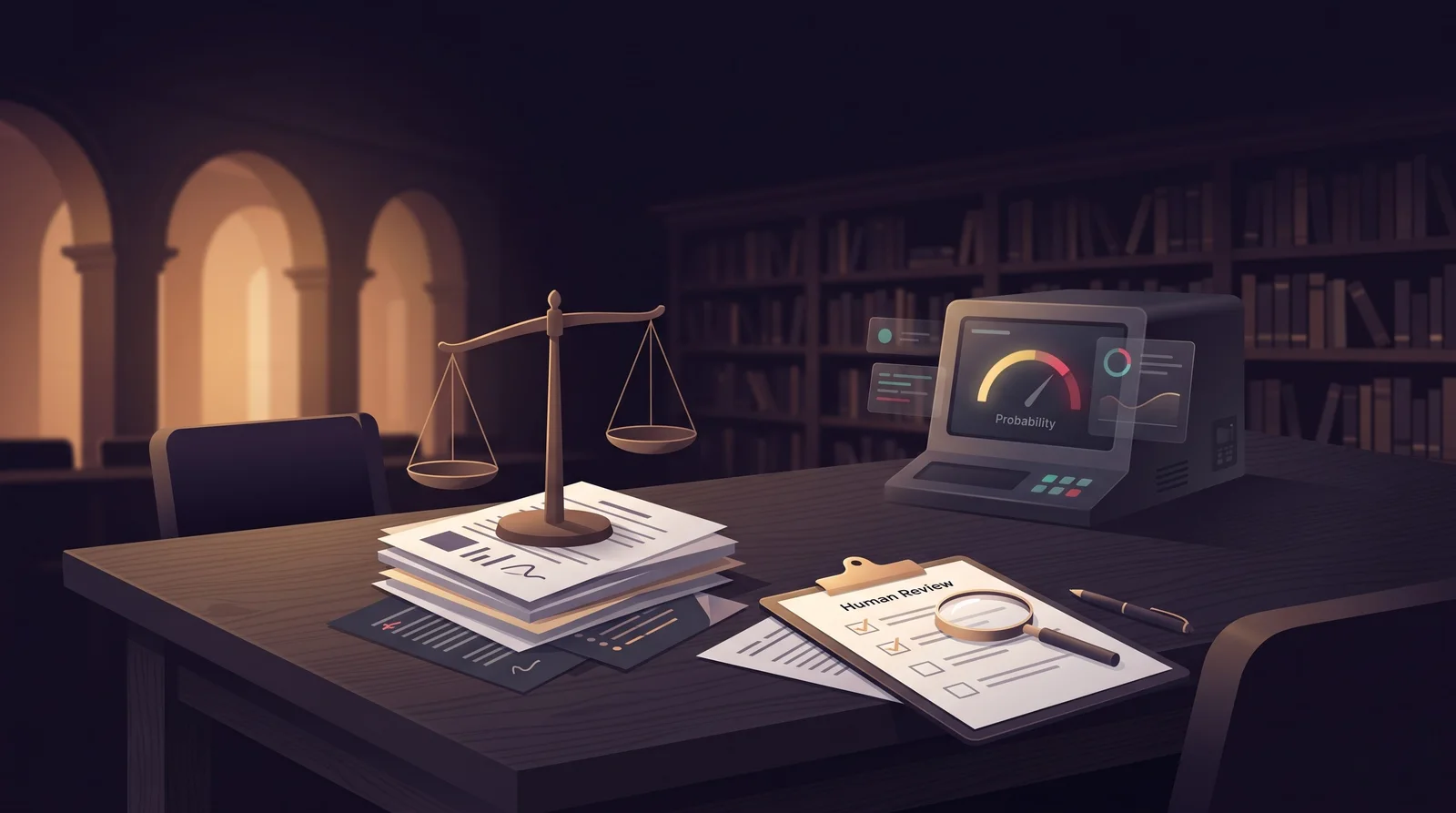
Recent reporting around universities limiting detector use, including coverage of Indiana University's Kelley School, reflects a larger shift: schools want better evidence than a single automated label. Researchers have also warned that detector performance can vary across writing styles, student backgrounds, and non-native English patterns.
So the question is not simply "Do AI detectors work?" The better question is: when should a detector score be trusted, and when should it trigger a careful human review instead?
The short answer
Universities are restricting AI detectors because the tools can:
- flag human-written work as AI-generated
- over-score polished or formulaic academic writing
- create extra risk for multilingual and ESL students
- produce scores that look more certain than they really are
- encourage punishment before evidence has been reviewed
That does not mean every detector is useless. It means detector scores should be treated as signals, not verdicts.
What changed in 2026?
AI detection used to feel like a simple arms race. Students used ChatGPT, schools used detectors, and the detector score became the conversation.
That model is now breaking down.
The writing process is more complicated than it was in 2023. Students might use AI for brainstorming, outlining, grammar cleanup, translation support, or citation organization. Some of that usage may be allowed. Some may not. But a final draft alone does not always reveal which kind of assistance happened.
At the same time, detectors have become part of a much larger ecosystem. Tools like GPTZero, Turnitin, and Originality.ai are not just niche products anymore. They shape how students think, revise, and defend their work.
That makes reliability more important, not less.
Why false positives are the core problem
A false positive happens when a human-written text is flagged as AI-generated.
This is the failure mode universities worry about most, because it reverses the burden of proof. Instead of the school proving misconduct, the student suddenly has to prove they wrote their own paper.
False positives happen because detectors do not observe the writing process. They analyze the final text and estimate whether its statistical patterns look more human or more machine-like.
Those patterns can include:
- predictable word choices
- low sentence variation
- repeated paragraph structure
- unusually smooth transitions
- formal but generic academic phrasing
The problem is obvious: human writers can produce those patterns too.
If a student writes carefully, edits heavily, uses formal academic language, or writes in a second language, their work can become more predictable. That does not make it AI-generated.
Multilingual students are especially exposed
One of the strongest arguments against detector-only enforcement is the risk to multilingual writers.
Research has found that GPT-style detectors can show bias against non-native English writing, because second-language prose is often more direct, more structurally regular, and less idiomatic than native-speaker writing. That can make honest work look statistically "AI-like" even when it was written by a human.
This is not a small ethical footnote. It changes the fairness of the system.
If a tool is more likely to flag certain groups of students, universities cannot treat that tool as a neutral judge. At best, it becomes one piece of context. At worst, it becomes a source of unequal accusation.
That is why detector policy is moving toward human review, drafting evidence, and instructor judgment.
Turnitin, GPTZero, and Originality.ai are not the same
It is tempting to talk about "AI detectors" as if they all work the same way. They do not.
| Detector | Common use case | Main risk |
|---|---|---|
| Turnitin | Academic submissions inside schools and universities | Students often cannot test the exact institutional version before submission |
| GPTZero | Student and educator-facing AI probability checks | Scores can shape anxiety even when they are not official evidence |
| Originality.ai | Web content, publishing, and SEO workflows | Aggressive scoring can flag borderline or heavily edited text |
If you want a deeper comparison, read our guide to GPTZero vs Turnitin vs Originality.ai.
The important point is that all three tools estimate risk. They do not prove intent.
Why a detector score feels more certain than it is
The design of AI detectors creates a psychological problem. A score like "72% AI" feels precise. It looks mathematical. It implies that the tool knows something specific.
But the score is not a camera recording the writing process. It is a model output.
That means it can be useful and limited at the same time.
A professor may see a high score and decide to ask questions. That can be reasonable. But if the score becomes the entire case, the process becomes unfair. A fair review should ask:
- Does the student have drafts or version history?
- Do the citations and notes match the final argument?
- Does the voice match previous work?
- Did the assignment policy allow any AI assistance?
- Are there signs of plagiarism or only an AI probability score?
- Could ESL, translation, or heavy grammar editing explain the pattern?
This is the difference between investigation and accusation.
What students should do if they are worried
If you are worried about AI detector scores, do not panic-edit your paper blindly. That can make the writing worse.
Instead, build an authorship trail.
Keep:
- outlines
- notes
- source lists
- rough drafts
- Google Docs or Word version history
- screenshots of major revisions
- professor feedback
- citation notes
If a detector flags your work, this evidence matters more than arguing with the score.
You can also use a tool like LegitWrite's AI humanizer to review whether your draft has overly predictable rhythm, generic transitions, or sections that read too mechanically. The goal should be clearer, more human writing — not hiding misconduct.
What to revise before submitting
The safest revision work is the same work good writers already do:
- Rewrite the introduction in your own voice.
- Replace generic transitions with specific logical connections.
- Vary sentence length naturally.
- Add concrete examples from your sources or class material.
- Make the conclusion less formulaic.
- Check that citations and claims match.
- Keep a draft history showing your process.
If your issue is specifically Turnitin anxiety, read our guide to bypassing Turnitin AI detection safely. If you write in Hindi or Arabic, our language-specific guides for Hindi AI text and Arabic AI text explain why native rhythm matters so much.
What instructors should do instead
The best institutions are not ignoring AI. They are improving the evidence standard.
Better academic integrity workflows include:
- clear AI-use policies before the assignment starts
- draft checkpoints
- oral follow-ups when authorship is unclear
- process-based grading
- version history review
- human review before any accusation
- extra caution for multilingual students
That approach is slower than trusting a score, but it is more defensible.
And defensibility is the point. A school can care about AI misuse without turning every detector score into a disciplinary case.
Are AI detectors still useful?
Yes, but only in the right role.
AI detectors can help identify text that deserves a closer look. They can help students see where a draft sounds too generic. They can help instructors notice patterns across submissions.
But they should not be used as the final decision.
The future of academic integrity is not "detectors or nothing." It is a mix of transparent policies, writing-process evidence, better revision habits, and human judgment.
The bottom line
Universities are banning or limiting AI detectors because the stakes are too high for a single automated score.
False positives can damage trust. Multilingual students can be unfairly exposed. Detector scores can look more certain than they are. And academic integrity decisions require more context than a model can see from the final text alone.
For students, the practical lesson is simple: write with a process you can defend. Keep drafts. Revise for real human clarity. Understand what detectors measure, but do not let one score define your authorship.
If you want to understand why human work gets flagged in the first place, read AI Detection False Positives: Why Human Writing Gets Flagged. If you are worried about how professors interpret AI signals, read Can Professors Tell If You Used ChatGPT?.